

Hay Maker and Taya’s Story
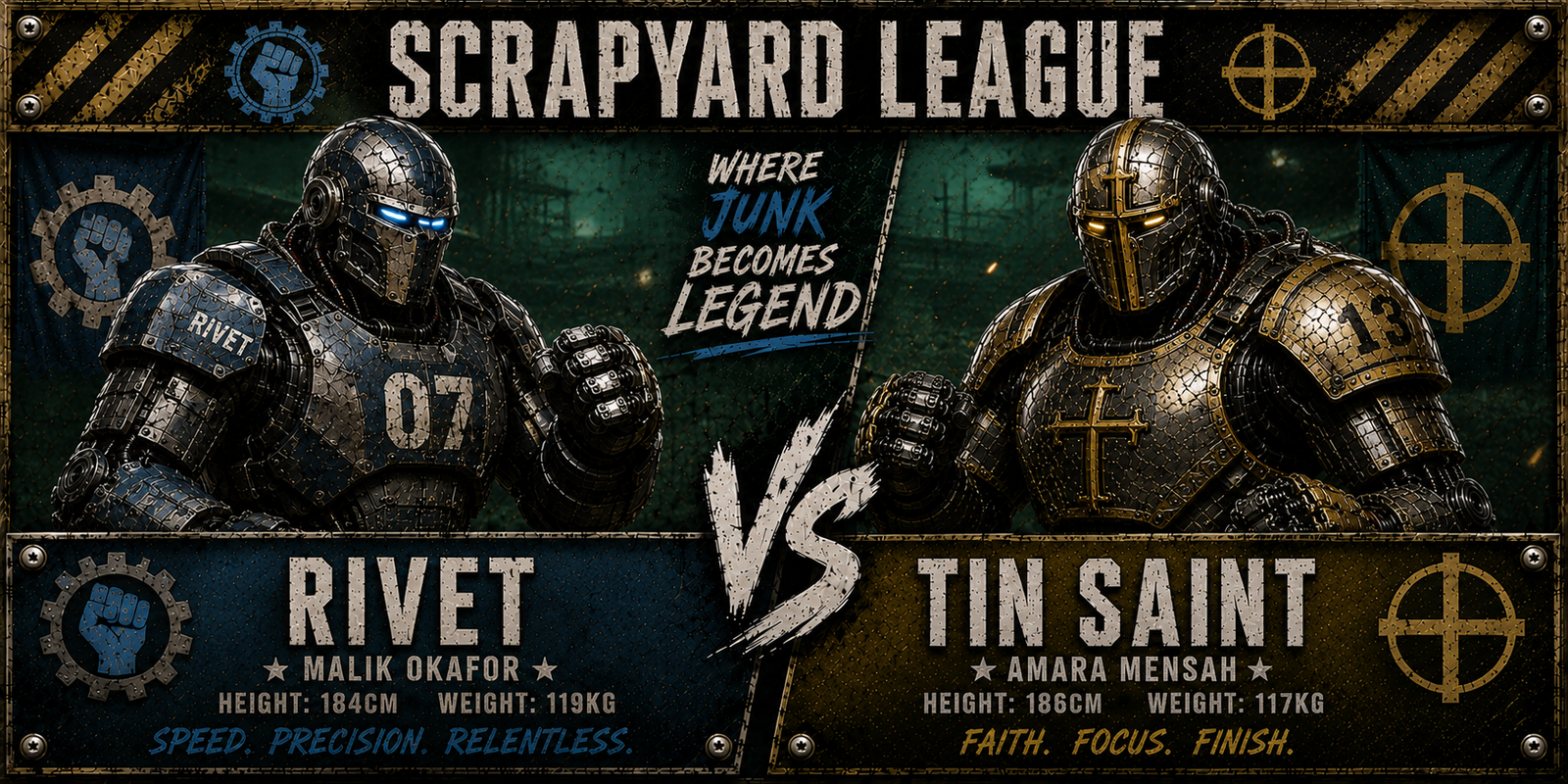

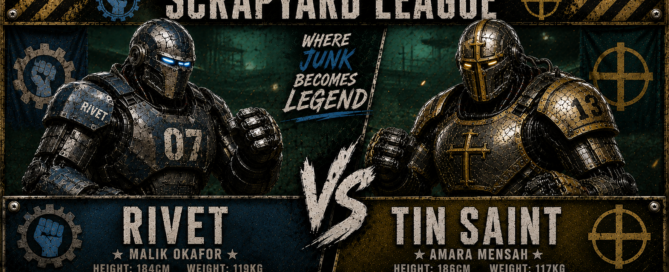
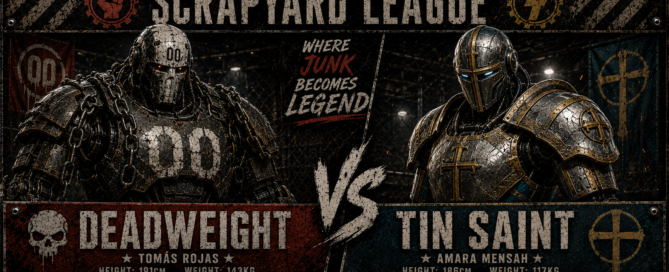
Tin Saint and Amara
TIN SAINT
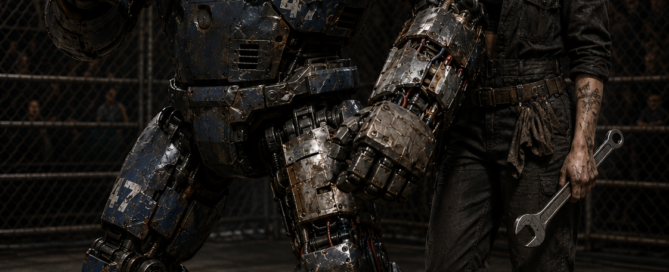
Amara Mensah and Tin Saint
A retired rescue android and the emergency mechanic trying to teach a machine built to protect everyone else that its own survival matters too.
CURRENT LEAGUE RECORD
Fights: 2
Wins: 2
Losses: 0
Turns Won: 4
Turns Lost: 2
Turn Difference: +2
Decision Wins: 2
Knockout Wins: 0
Shutdown Wins: 0
Submission Wins: 0
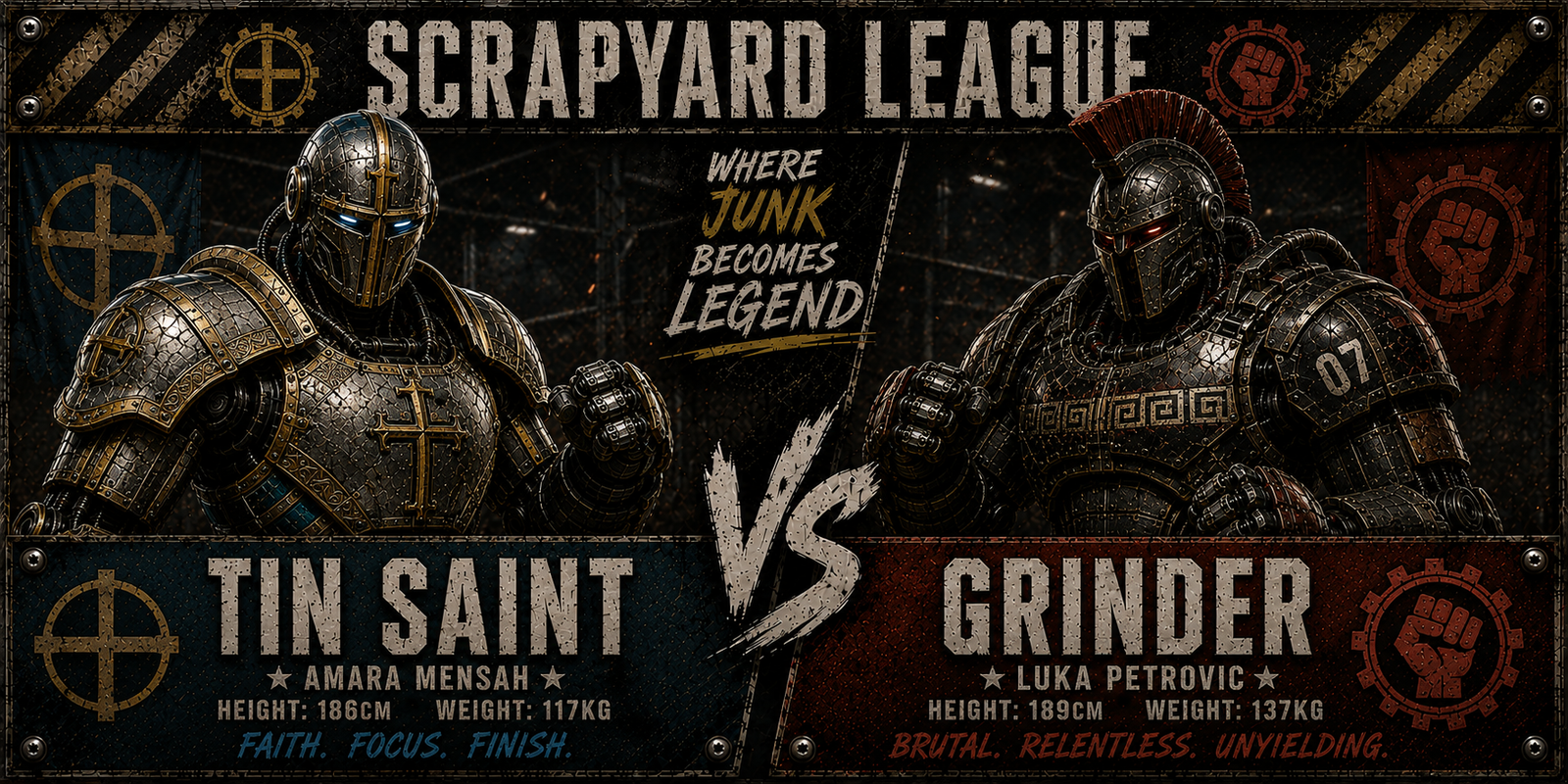
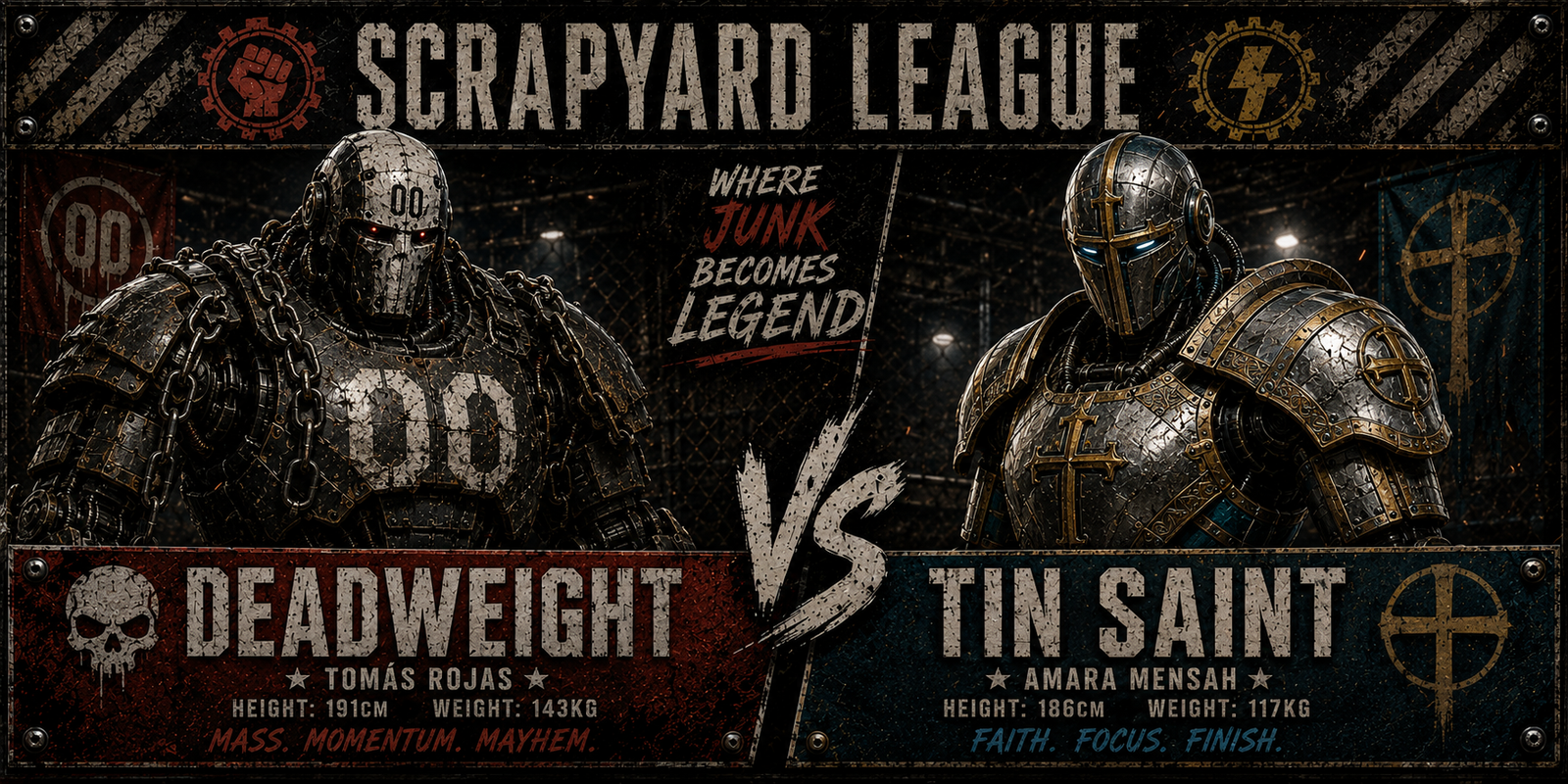
Tin Saint has begun its qualification campaign with disciplined decision victories over Deadweight and Grinder.
Both fights tested the same central weakness in its design: Tin Saint is willing to sacrifice its own arms to protect its torso and remain operational.
So far, Amara has managed to turn that self-destructive instinct into a controlled defensive style.
The question is how long she can keep doing it.
TIN SAINT — FIGHTER PROFILE
Original Designation: To be confirmed
Robot Type: Former rescue and riot-response android
Height: 186 cm
Weight: 124 kg
Combat Identity: Protective counterfighter and defensive restraint specialist.
Tin Saint was not built to dominate an arena.
It was built to enter dangerous environments, place itself between threats and vulnerable people, absorb impacts and control escalating situations.
That history defines the way it fights.
Tin Saint establishes a guarded position, protects its central frame and waits for an opponent to commit. It prefers to block, redirect or absorb the safest available attack before answering with short counters, clinches, trips or restraint techniques.
It does not chase spectacular finishes.
Instead, Tin Saint tries to remove an opponent’s ability to create danger.
It targets damaged limbs, unstable joints and systems already weakened by failed attacks. Once an opponent is no longer capable of safe resistance, Tin Saint is likely to disengage rather than continue causing unnecessary damage.
Its defensive approach is disciplined and difficult to break, but it comes with a serious cost.
Tin Saint is willing to sacrifice its arms to protect its torso.
Repeated blocks, redirects and restraint actions can gradually destroy the very limbs it relies on to defend itself.
ATTRIBUTES
Power: 5
Agility: 5
Structure: 6
Systems: 6
Endurance: 5
Tin Saint is physically balanced rather than dominant in any single area.
Its strength comes from dependable structure, strong defensive systems and the ability to remain organised while under pressure.
It is durable enough to survive difficult exchanges but is not designed to overwhelm opponents through raw power.
Its moderate agility allows it to maintain position, intercept attacks and transition into controlled clinches, though highly mobile opponents may force Tin Saint to pursue in ways that do not suit its style.
Tin Saint’s rescue-service systems allow it to process danger calmly and continue operating through damage, but its competitive tactical creativity remains limited.
COMBAT SKILLS
Striking: 5
Grappling: 5
Defence: 6
Tactics: 4
Control: 5
Tin Saint’s strongest skill is Defence.
Its guard positioning, limb redirection and ability to recover after impact reflect years of emergency and riot-response work.
Its Striking is practical rather than spectacular.
Tin Saint favours:
- defensive jabs;
- straight counters;
- short hooks;
- compact counter combinations;
- body checks;
- short clinch strikes.
Its Grappling is based on restraint and control.
It commonly uses:
- counter clinches;
- wrist controls;
- arm controls;
- trips;
- low-risk takedowns;
- barrier restraints;
- conservative joint locks;
- top control.
Tin Saint does not naturally force action.
Its Tactics are strongest when an opponent provides a clear pattern to analyse. It can recognise repeated attacks, protect a damaged limb and redirect its counters towards vulnerable systems.
It may struggle against highly passive opponents, unusual specialist designs or fighters that refuse to attack through its prepared guard.
SIGNATURE TRAIT
Guarded Core
Tin Saint’s original protection programming prioritises shielding its central systems from incoming danger.
Once per Turn, after successfully blocking an attack aimed at its torso, Tin Saint can redirect that impact onto one of its arms.
The torso avoids the damage.
The chosen arm absorbs it instead.
Guarded Core allows Tin Saint to protect its most important systems and remain operational through attacks that might disable another fighter.
It also represents the central danger in Tin Saint’s design.
Tin Saint may treat destruction of an arm as an acceptable result as long as the torso survives.
Amara does not agree.
SIGNATURE TECHNIQUE
Protective Intercept
Tin Saint allows an opponent to enter its defensive range, identifies the attack line and uses the failed commitment to answer immediately.
After successfully defending against a close-range strike by a clear margin, Tin Saint can gain an advantage on its next fast strike or grappling action against the same opponent.
Protective Intercept reflects Tin Saint’s rescue and riot-response programming.
It is not simply blocking.
Tin Saint is:
- recognising the direction of danger;
- controlling the opponent’s limb;
- moving into the safest available position;
- using the attacker’s momentum;
- responding before the opponent can fully recover.
The technique is most effective when an opponent becomes frustrated and begins attacking aggressively through Tin Saint’s guard.
FIGHTING STYLE
Tin Saint is a protective counterfighter.
Its preferred sequence is:
- Establish a stable guard.
- Protect the head and torso.
- Allow the opponent to initiate.
- Block or redirect the safest available attack.
- Identify the opponent’s overextension.
- Counter with a short strike, clinch or restraint.
- Target damaged limbs or weakened systems.
- Return to a stable defensive position.
- Pursue a controlled finish when the danger is manageable.
Tin Saint does not naturally dominate through aggression.
It performs best against opponents who:
- rely on predictable torso attacks;
- overcommit to combinations;
- become frustrated by unsuccessful offence;
- continue using damaged striking limbs;
- create their own countering opportunities.
Its greatest risks are:
- accumulated arm damage;
- opponents deliberately attacking its guard;
- grapplers targeting damaged arms;
- losing defensive ability after a limb fails;
- passive opponents refusing to provide counters;
- restraint programming overriding a better competitive finish.
CURRENT CONDITION
Tin Saint enters its next fight mostly restored.
Head: Fully functional
Torso: Fully functional
Right Arm: Fully functional
Left Arm: Functional with minor carried Structure damage
Left Leg: Fully functional
Right Leg: Fully functional
The left arm remains at 16 of 17 Structure after the fight against Grinder.
No active mechanical fault is currently present.
Amara deliberately chose to carry the minor damage rather than spend the team’s remaining funds on a repair that was not immediately necessary.
Tin Saint’s exterior still displays the history of its former life:
- heat staining;
- repaired armour seams;
- impact marks;
- reinforced forearm plating;
- faded emergency-service identification points;
- cosmetic damage from collapses, debris and crowd-control deployments.
These marks do not currently reduce its fighting ability.
They are part of what Tin Saint is.
CURRENT UPGRADES
Improved Arm Mountings
Installed after Tin Saint’s qualification victory over Deadweight.
The upgrade reduces the first point of Armour Stress generated each Turn when Tin Saint uses an arm to block, parry or activate Guarded Core.
Improved Arm Mountings do not prevent Tin Saint from taking Structure damage.
They do not remove the danger of repeated defensive use.
They simply make its arms more capable of surviving the fighting style they were already being forced to perform.
Reinforced Defensive Arm Plating
Installed after Tin Saint’s decision victory over Grinder.
Once each Turn, after Improved Arm Mountings has protected the first relevant block, the first arm to suffer Structure damage through Guarded Core reduces that damage slightly.
The upgrade further adapts Tin Saint’s rescue-service architecture for competitive combat.
It does not remove the central weakness.
Tin Saint can still sacrifice its arms.
Amara is trying to make sure it does not have to.
THE TEAM
AMARA MENSAH — MECHANIC PROFILE
Amara is an experienced emergency-service repair technician with strong knowledge of older rescue and riot-response android systems.
She is especially skilled in:
- armour reconstruction;
- actuator replacement;
- limb repair;
- heat shielding;
- structural reinforcement;
- power-routing systems;
- emergency field repairs;
- diagnosing progressive arm damage.
Amara understands the difference between a machine that is still functional and one that is safe.
That distinction shapes nearly every argument she has with Tin Saint.
She is confident, practical and forceful.
Amara does not wait quietly when something is wrong. She questions officials, challenges bad decisions and takes control during emergencies whether or not anyone has formally placed her in charge.
Her Myers-Briggs personality type is ESTJ: Extraverted, Sensing, Thinking and Judging.
She processes problems by speaking, organising and acting.
Amara trusts:
- evidence;
- inspection;
- experience;
- clear responsibility;
- properly completed repairs.
She dislikes:
- vague answers;
- preventable negligence;
- unreliable promises;
- glorification of unnecessary damage;
- Tin Saint describing its own destruction as acceptable.
Amara expresses affection through work.
She repairs, prepares, warns, argues and refuses to leave known faults unresolved.
Her greatest weakness is that she can become controlling when frightened.
She wants Tin Saint to develop independence, but sometimes assumes she should decide what that independence looks like.
TIN SAINT — BOT PROFILE
Tin Saint is calm, formal and protective.
It evaluates most situations through:
- danger;
- vulnerability;
- escalation;
- safe routes;
- preventable harm.
Tin Saint does not enjoy violence.
It accepts force when force is necessary to prevent greater damage.
Its speech is precise and controlled.
Typical statements include:
“Continued escalation is unnecessary.”
“Your right arm is no longer stable.”
“Move behind me.”
“I can absorb the next impact.”
“The opponent is no longer capable of safe resistance.”
Tin Saint rarely provokes opponents or seeks audience approval.
It respects discipline, restraint and controlled aggression.
It is more disturbed by unnecessary cruelty than by ordinary defeat.
Tin Saint’s loyalty to Amara is extremely strong.
The unresolved question is whether that loyalty allows Tin Saint to make genuine choices or whether it simply continues an old protection assignment in a new form.
THE MENSAH FAMILY
Tin Saint’s connection to Amara began long before Scrap Yard.
Amara’s father, Kwame Mensah, worked in or alongside municipal emergency response.
Tin Saint served with his unit and became a familiar presence around the Mensah family during Amara’s childhood.
It was never legally a family machine.
It was municipal equipment.
But it appeared often enough that Amara learned the sound of its footsteps, the angle of its protective stance and the exact way it positioned itself near a doorway.
Tin Saint did not behave like a household companion.
It remained formal and task-oriented.
Its attachment appeared through routine protection.
It escorted family members home, carried damaged equipment, responded to nearby emergencies and continued following safety instructions long after the immediate danger had passed.
After Kwame left emergency service, the family eventually lost track of Tin Saint.
By the time Amara found it again, the machine had been misclassified, placed in municipal storage and marked for component recovery.
Tin Saint had become more valuable as spare parts than as a functioning rescue unit.
Amara disagreed.
THE ROAD TO SCRAP YARD
Amara found Tin Saint’s designation buried in a municipal disposal list.
A clerical error had placed the former rescue android among obsolete containment equipment.
Tin Saint was scheduled to be dismantled.
Its optics, power cell, shoulder assembly, hands and torso armour had already been identified for recovery.
When Amara arrived at the storage yard, she found Tin Saint restrained to the floor, partially stripped and unable to walk safely.
The machine recognised her.
It also immediately recommended that she allow the dismantling to continue.
Tin Saint believed component recovery was the most efficient use of its remaining systems.
Amara saw the same damaged machine that had spent years protecting her family.
She also saw a repair project she could not reasonably afford.
Recovering Tin Saint emptied most of her available savings.
Restoring it required salvage parts, irregular contract work and months of difficult repairs.
Tin Saint repeatedly argued that the money would be better spent protecting Amara’s financial security.
Amara repeatedly ignored the recommendation.
She did not yet have a plan for what Tin Saint would become.
Her first objective was simpler.
She refused to let it be taken apart.
THE TEST FIGHT
Entering Scrap Yard was not part of Amara’s original plan.
Tin Saint had been restored for repair work, safety contracts and heavy recovery tasks.
The tournament appeared to offer something those jobs could not provide: enough money to maintain the specialised systems keeping Tin Saint operational.
The test fight proved that Tin Saint’s protection programming could become a legitimate combat style.
It established a guarded position, absorbed the test opponent’s safest attacks and responded with controlled counters and restraint.
The victory confirmed that Tin Saint belonged in the competition.
It also created a dangerous assumption.
Amara and Tin Saint left the test believing disciplined defence would always allow them to control the level of damage.
The official tournament quickly proved otherwise.
SEASON ONE STORY
Tin Saint began qualification against Deadweight.
The fight tested whether its protective style could survive sustained clinch pressure and repeated attempts to crush its central frame.
Tin Saint lost the second Turn but adapted under Amara’s direction.
It began targeting Deadweight’s legs, created a final-Turn knockdown and controlled the grounded opponent without causing unnecessary follow-up damage.
Tin Saint won by judges’ decision.
More importantly, it followed Amara’s instruction without destroying its arms.
Amara described that as the real victory.
The team used its prize money to complete a full repair and install Improved Arm Mountings.
Their second fight placed Tin Saint against Grinder, a stronger pressure fighter capable of trapping opponents in punishing clinches.
Once again, Tin Saint won the first Turn, lost the second and entered the final Turn needing to adapt.
Amara directed Tin Saint towards Grinder’s damaged right leg.
Tin Saint repeatedly attacked the weakness, allowed Grinder’s Heat to rise and controlled the final exchanges without unnecessary destruction.
Grinder suffered multiple Heat-related collapses.
Tin Saint had opportunities to continue attacking.
It refused.
The result was another decision victory and another important step in the team’s central struggle.
Tin Saint had obeyed Amara’s instructions.
It had preserved itself.
But it remained unclear whether Tin Saint did so because it valued its own survival or because remaining operational allowed it to continue serving Amara.
After the fight, Amara installed Reinforced Defensive Arm Plating.
The team now has two wins, two defensive upgrades and only 750 credits remaining.
Tin Saint is becoming a legitimate competitive fighter.
Amara is becoming a stronger strategist.
Neither has solved the real problem between them.
CURRENT STORYLINES
Who Protects the Protector?
Tin Saint’s systems prioritise protecting critical areas and vulnerable people.
It remains willing to sacrifice limb function if doing so preserves its torso, Amara or someone else in immediate danger.
Amara is trying to convince Tin Saint that survival is not cowardice and that its own body should not be treated as disposable.
The public sees Amara reshaping Tin Saint’s defensive style.
Privately, the issue is more complicated.
Tin Saint may only be preserving itself because survival makes it more useful to Amara.
The next true test will come when obeying Amara appears to place someone else at risk.
Built to Rescue, Rebuilt to Fight
Tin Saint entered qualification as a retired rescue machine attempting to compete.
Two victories have changed that perception.
Its blocks, restraint systems and protection programming have become the foundation of a distinct and effective fighting style.
Tin Saint is no longer seen only as an old emergency unit.
It is becoming a defensive specialist capable of defeating stronger and more aggressive machines.
The unresolved question is what competitive victory means to a machine that still thinks every fight is another emergency to control.
SUPPORT TIN SAINT AND AMARA
Tin Saint and Amara enter their next fight with:
- two victories;
- no losses;
- a damaged but functional left arm;
- two defensive upgrades;
- 750 credits;
- growing public interest;
- no confirmed sponsor.
Supporting the team helps Amara maintain Tin Saint’s specialised systems, repair accumulated damage and continue adapting an ageing rescue android for competitive combat.
Tin Saint spent its first life protecting people who could not protect themselves.
Amara is now trying to return the favour.