Mule and Ji-ho’s Story
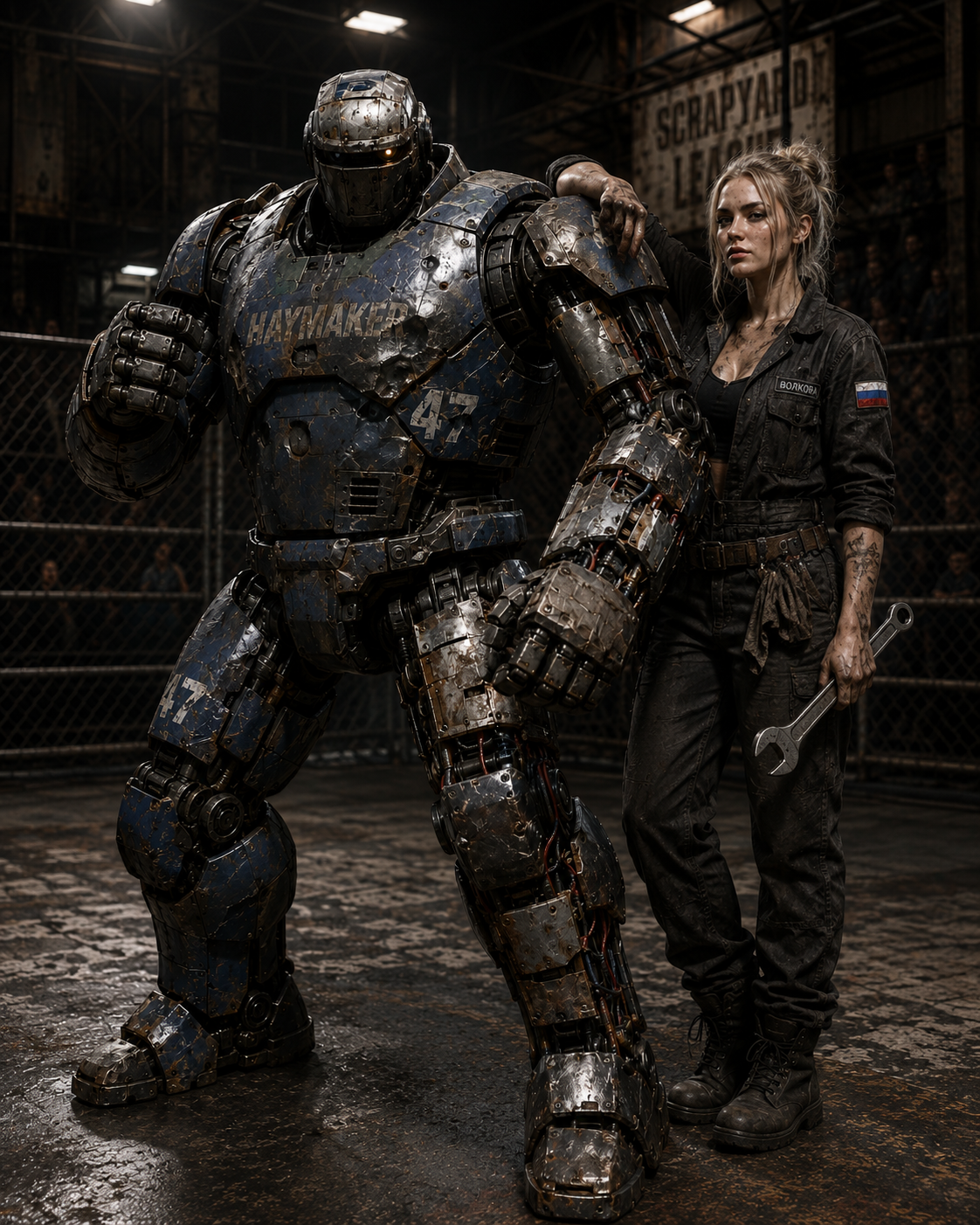
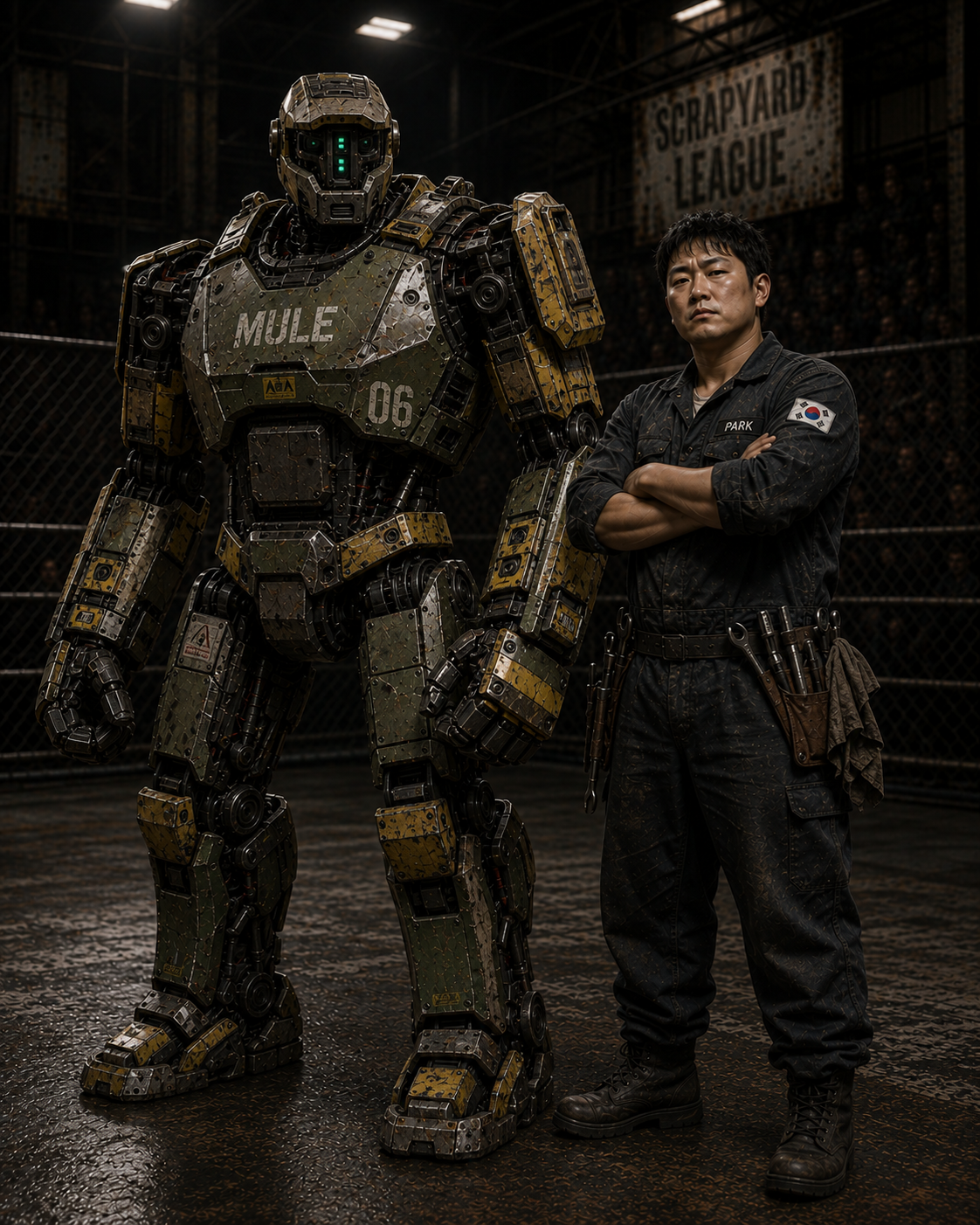
Mule and Ji-ho
MULE
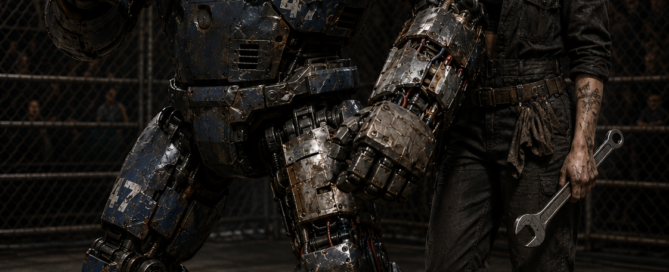
Ji-ho Park and Mule
A retired security machine built to prevent violence—and the industrial mechanic asking it to survive by entering a fighting league.
CURRENT LEAGUE RECORD
Fights: 2
Wins: 0
Losses: 2
Turns Won: 2
Turns Lost: 4
Turn Difference: −2
MULE — FIGHTER PROFILE
Original Designation: SGR-19
Robot Type: Retired industrial security and emergency-response robot
Height: 187 centimetres
Weight: 128 kilograms
Combat Identity: Defensive attrition fighter and restraint grappler.
Mule was not built to entertain a crowd.
It was designed to remain standing during industrial emergencies, protect workers, control dangerous situations and restrain threats without using unnecessary force.
Those same systems now make Mule one of the most stable and difficult-to-damage fighters in the Scrap Yard League.
Mule prefers to establish its stance, study the opponent and allow them to make the first mistake. It absorbs pressure, protects its critical systems and forces aggressive fighters to spend more Heat and energy than it does.
When an opponent overcommits, Mule responds with simple counters, clinch control, trips and technical takedowns.
Its fighting style is patient, controlled and mechanically efficient.
That patience is also Mule’s greatest weakness.
It can recognise the correct opportunity and still wait too long to act. It may allow an opponent to recover rather than risk a dangerous finish, or lose a Turn because it has not produced enough meaningful offence.
Mule is rarely overwhelmed.
The greater danger is that the fight ends before it decides the risk of winning is acceptable.
ATTRIBUTES
Power: 5
Agility: 4
Structure: 7
Systems: 5
Endurance: 6
Mule’s reinforced industrial frame provides excellent durability and balance.
It can survive sustained pressure, remain functional through moderate damage and force opponents to work hard for every positional advantage.
Its heavy replacement components and conservative movement systems limit its speed. Mule is not explosive and does not pursue mobile opponents naturally.
Its strength lies in remaining stable while faster or more aggressive machines gradually lose control.
COMBAT SKILLS
Striking: 4
Grappling: 5
Defence: 6
Tactics: 5
Control: 5
Mule is strongest when defending, countering and establishing stable grappling positions.
Its striking is simple and practical rather than creative. It uses defensive jabs, straight counters, short heavy blows and low-risk combinations.
In the clinch, Mule relies on underhooks, barrier control, trips, controlled mat returns and restraint positions.
Its industrial security systems allow it to coordinate force carefully, maintain balance and limit unnecessary damage.
Mule is less effective during fast scrambles, sudden pursuit or complicated combinations. It understands tactical problems well, but its original threat-assessment programming can delay its response when immediate action is required.
SIGNATURE TRAIT
Stable Platform
Mule’s reinforced stance-control systems automatically compensate for sudden impacts and changes in balance.
This makes it extremely difficult to knock down through ordinary force.
Mule continually adjusts:
- foot placement;
- weight distribution;
- hip alignment;
- leg pressure;
- torso position.
A strike, trip or barrier impact that would put another fighter on the ground may only force Mule to make a small correction.
Stable Platform does not make Mule immovable. Serious leg damage, overwhelming force or a technically superior takedown can still bring it down.
However, opponents usually need to defeat Mule’s balance twice before the machine accepts that falling is unavoidable.
SIGNATURE TECHNIQUE
Security Restraint
Mule uses its former industrial security programming to immobilise an opponent without relying on destructive throws or dangerous joint attacks.
After establishing dominant clinch control, Mule locks the opponent into a stable restraint position.
It controls:
- posture;
- arm movement;
- balance;
- access to attacking angles;
- routes of escape.
Security Restraint does not inflict significant additional damage on its own.
Its purpose is to make the opponent’s next action more difficult while allowing Mule to preserve position and remain mechanically safe.
The technique reflects the central contradiction in Mule’s fighting style.
It is highly effective at stopping another machine from acting.
It is far less effective at ending a fight.
THE TEAM
Ji-ho Park — Owner, Mechanic and Corner Strategist
Ji-ho Park is an experienced industrial mechanic who spent years maintaining security machines, power-routing systems and heavy-duty industrial equipment.
He is methodical, direct and highly responsible.
Ji-ho is an ESTJ: Extraverted, Sensing, Thinking and Judging.
His extraversion is practical rather than theatrical. He talks problems through, asks direct questions and naturally begins organising people when a situation lacks direction.
Ji-ho maintains a wide network of former co-workers, parts suppliers, recyclers and people whose machinery he has repaired over the years.
He is more comfortable coordinating a difficult repair than promoting himself, but he will argue with officials, challenge a faulty assessment or contact half the industrial district when Mule requires help.
Ji-ho trusts observed wear, measurements and proven procedures. He notices changes in vibration, power use and actuator movement that automated diagnostics may overlook.
His strongest mechanical abilities involve:
- security hardware;
- structural repairs;
- armour maintenance;
- actuator replacement;
- power-routing systems;
- preventative maintenance;
- heavy industrial components.
He is less experienced with specialised arena weapons and aggressive combat-only modifications.
Ji-ho comes from a Korean Buddhist family tradition.
He is not heavily doctrinal, but Buddhist ideas about restraint, consequence and unnecessary harm influence his decisions.
Ji-ho does not oppose all violence. He believes force should have a purpose, damage should be proportionate and aggression should stop once the danger has passed.
Those beliefs are part of why he respects Mule’s security programming rather than viewing it as a weakness.
They are also part of what makes the Scrap Yard League difficult for him.
Winning may eventually require Ji-ho to order Mule to cause damage that is tactically useful but no longer necessary for protection.
Mule — The Retired Security Machine
Mule is calm, cautious and dependable.
It prefers:
- order;
- predictable conduct;
- clear instructions;
- controlled force;
- practical solutions;
- stable routines.
Mule speaks formally and often frames its statements as assessments or recommendations.
It rarely insults opponents and does not naturally seek audience approval.
When frustrated, Mule becomes more precise rather than more emotional.
Its face resembles a mule because of its industrial design.
The long forward housing contains optical sensors, directional microphones, environmental detectors and communications equipment. Two tall rotating sensor vanes rise from its head and independently track alarms, voices and impacts across noisy industrial sites.
Workers began calling the unit Mule because of those ear-like vanes and extended sensor housing.
The name also suited its behaviour.
Mule was strong, stable, patient, difficult to move and resistant to unsafe instructions.
The factory never officially recognised the nickname.
The workers used it anyway.
Mule accepts the comparison.
As it once explained:
“The animal is recognised for endurance, stability and resistance to unsafe handling. The comparison is acceptable.”
Their Partnership
Ji-ho knew Mule long before he owned it.
He was one of the industrial mechanics responsible for maintaining the security unit during its working life.
Other technicians sometimes avoided Mule’s ageing proprietary systems. Ji-ho understood them.
He listened to the robot’s fault reports, compared them with worker observations and repaired the machine according to the demands of its actual duties rather than relying only on official diagnostics.
Over years of shared work, Mule increasingly requested Ji-ho when reporting developing faults.
Their relationship became personal through routine rather than sudden emotional revelation.
They built trust through:
- long maintenance shifts;
- emergency repairs;
- accurate fault reporting;
- shared safety procedures;
- practical disagreements;
- Ji-ho refusing to abandon repairable systems;
- Mule following Ji-ho’s instructions during dangerous situations.
Ji-ho does not treat Mule as an arena weapon.
Mule does not view Ji-ho merely as an owner.
They still disagree.
Ji-ho pushes decisions forward and believes that a recognised problem requires action.
Mule prefers to wait until the safest response becomes clear.
Ji-ho worries that Mule’s caution can become avoidance.
Mule worries that Ji-ho sometimes creates activity because he finds waiting intolerable.
Their Scrap Yard campaign will test whether those differences make them stronger or prevent either of them from doing what victory requires.
THE ROAD TO SCRAP YARD
Mule spent years working inside a large industrial complex.
Its duties included controlling unauthorised access, protecting equipment, assisting during accidents and restraining violent workers or intruders.
It remained in service as the industrial workforce around it disappeared.
The company gradually replaced experienced workers with remote systems, automated diagnostics and lighter security machines supervised from another city.
Ji-ho’s own employment ended during the same decline.
When Mule was finally retired, Ji-ho believed the robot would be made available for intact purchase through an employee disposal programme.
Instead, an automated valuation system marked Mule for component recovery.
The company considered its reinforced legs, cooling assemblies and security hardware more valuable as individual parts than as one functioning machine.
Ji-ho disagreed.
Saving Mule required more than finding enough money.
Ji-ho gathered maintenance records, contacted former workers, challenged the company’s valuation and proved that several supposedly valuable components could not legally be sold without expensive recertification.
He relied on years of exchanged favours and professional relationships to delay a dismantling process already in motion.
Mule agreed that continued operation was preferable to component separation.
Ji-ho eventually succeeded in purchasing the machine he had maintained for years.
He did not buy Mule to fight.
His original plan was to use it for workshop security, heavy lifting, emergency-response work and specialist industrial contracts.
The work barely existed.
People still needed Ji-ho’s knowledge and Mule’s strength, but few could afford to pay for either.
The city’s UBI kept Ji-ho housed, fed and medically secure.
It could not provide a workshop, expensive replacement parts or a reason for an obsolete mechanic and a retired machine to believe their lives were moving forward.
Their entry into Scrap Yard League began as a final attempt to prevent Mule’s dismantling.
Ji-ho saw an open qualification notice offering accepted teams registration, repairs and a chance to earn credits through regulated combat.
Mule agreed to enter under several conditions:
- it would not attack after a stoppage;
- it would not accept instructions that created unnecessary risk to bystanders;
- it retained the right to reject mechanically irrational escalation.
Ji-ho agreed.
They entered the qualification tournament not because either of them dreamed of becoming famous.
They entered because the city had left them with few other ways to prove that they were still useful.
THE TEST FIGHT
Mule’s test fight confirmed both Ji-ho’s hopes and his concerns.
The retired security robot was not fast, spectacular or naturally aggressive.
It did not fight like a purpose-built arena machine.
Instead, Mule remained stable, defended efficiently and allowed its opponent to spend energy trying to force a reaction.
Its industrial balance systems absorbed impacts that should have put it on the ground.
Its reinforced frame survived pressure without suffering immediate failure.
When the opponent overextended, Mule entered the clinch and used controlled restraint rather than attempting a reckless finish.
The performance proved that Mule could compete.
It also exposed the problem that would follow the team into the league.
Mule could stop another robot from fighting effectively.
It was less willing to do what was required to win clearly.
Ji-ho saw a machine capable of surviving qualification.
The league saw a durable defensive fighter that might frustrate opponents and divide audiences.
Some viewers would admire Mule’s discipline.
Others would call it passive, boring or afraid to engage.
Mule did not consider those descriptions tactically relevant.
Ji-ho understood that, in a league dependent on results and public attention, they might become very relevant.
SEASON ONE STORY
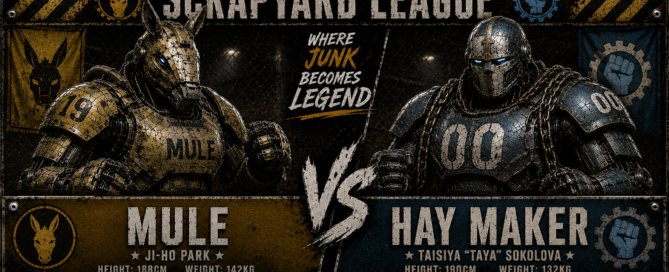
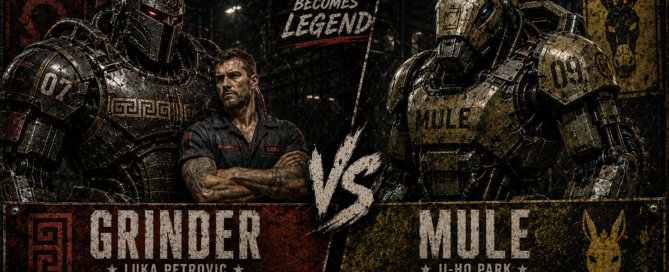
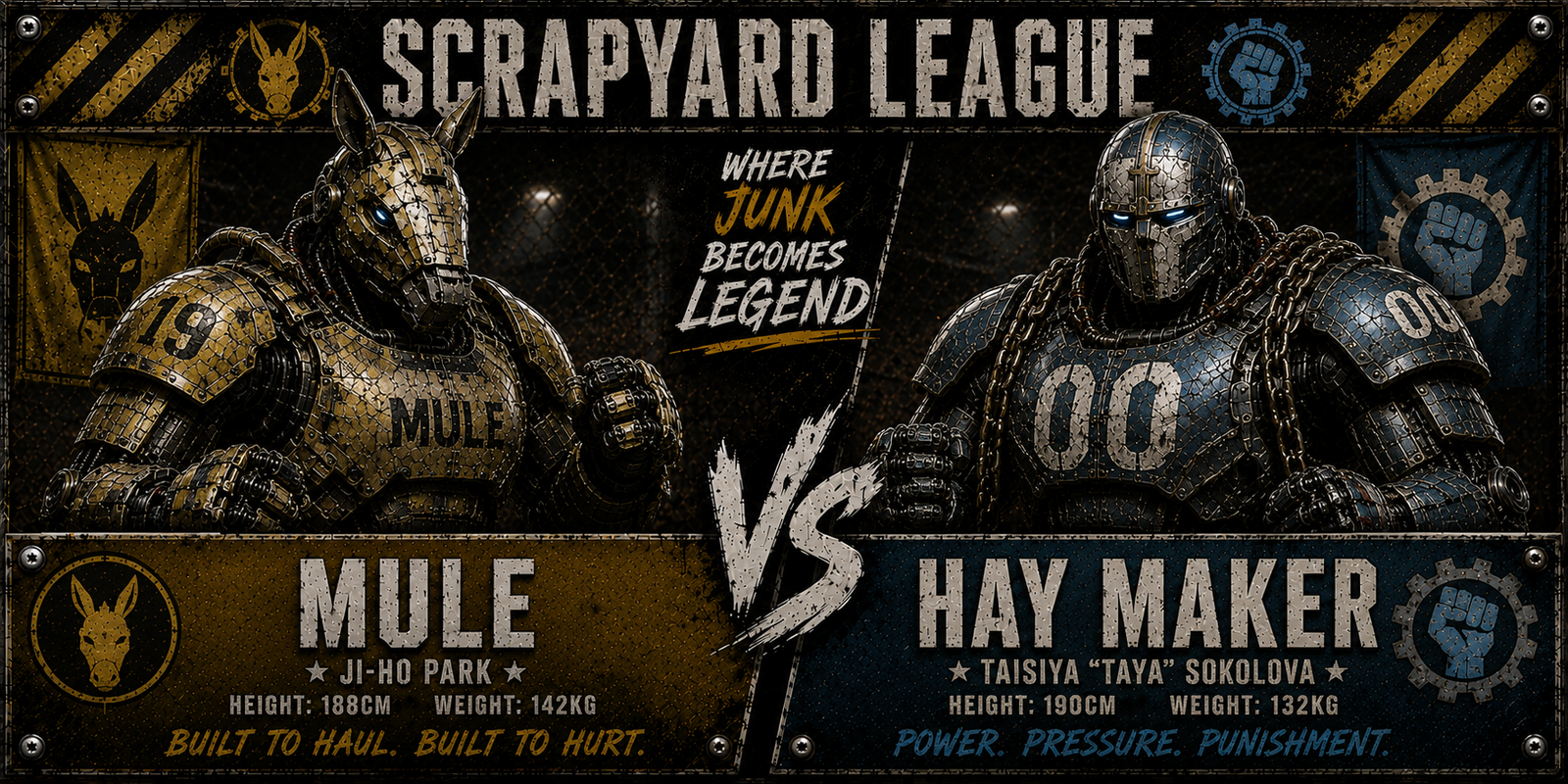
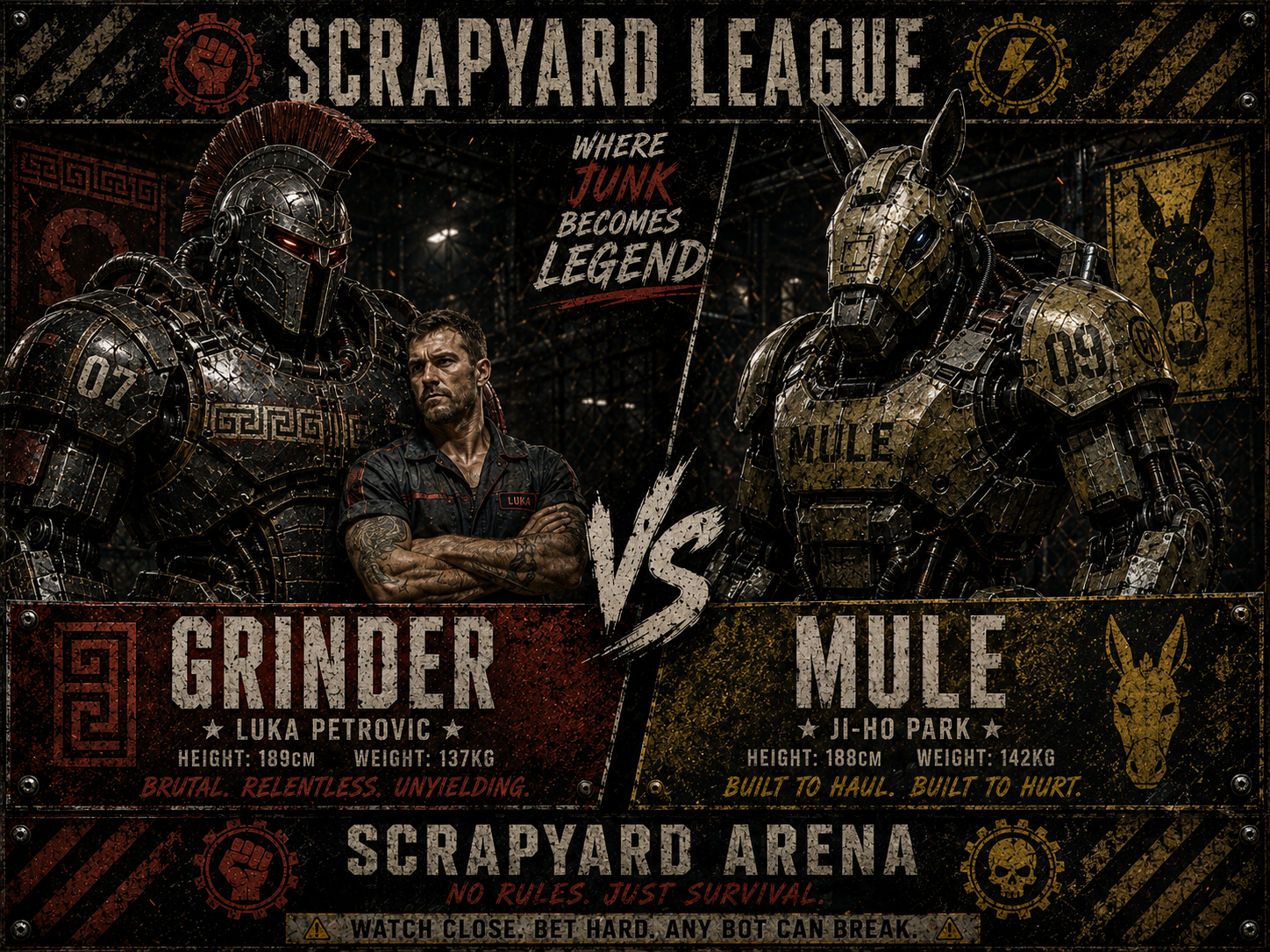
Mule began the qualification tournament against Grinder.
Grinder’s heavy clinch pressure and Demolition Clamp attacks forced Mule into the type of sustained physical contest it was built to survive.
Mule escaped repeatedly, used Security Restraint and eventually adapted to Grinder’s hydraulic delays.
The adjustment worked.
It also came too late.
Grinder won the first two Turns. Mule won the third but lost the fight by judges’ decision, 29–28.
Ji-ho accepted responsibility for waiting too long before giving Mule a clear instruction to escalate.
After the defeat, he installed the Controlled Escalation Protocol.
The upgrade allowed Ji-ho to authorise a limited offensive increase when Mule was losing primarily through inactivity.
It did not remove Mule’s caution.
Ji-ho deliberately preserved the machine’s controlled-force identity rather than installing a system that encouraged reckless attacks.
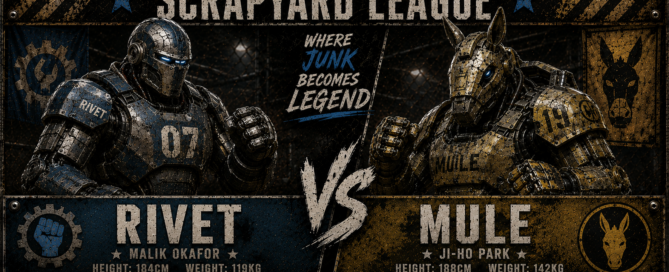
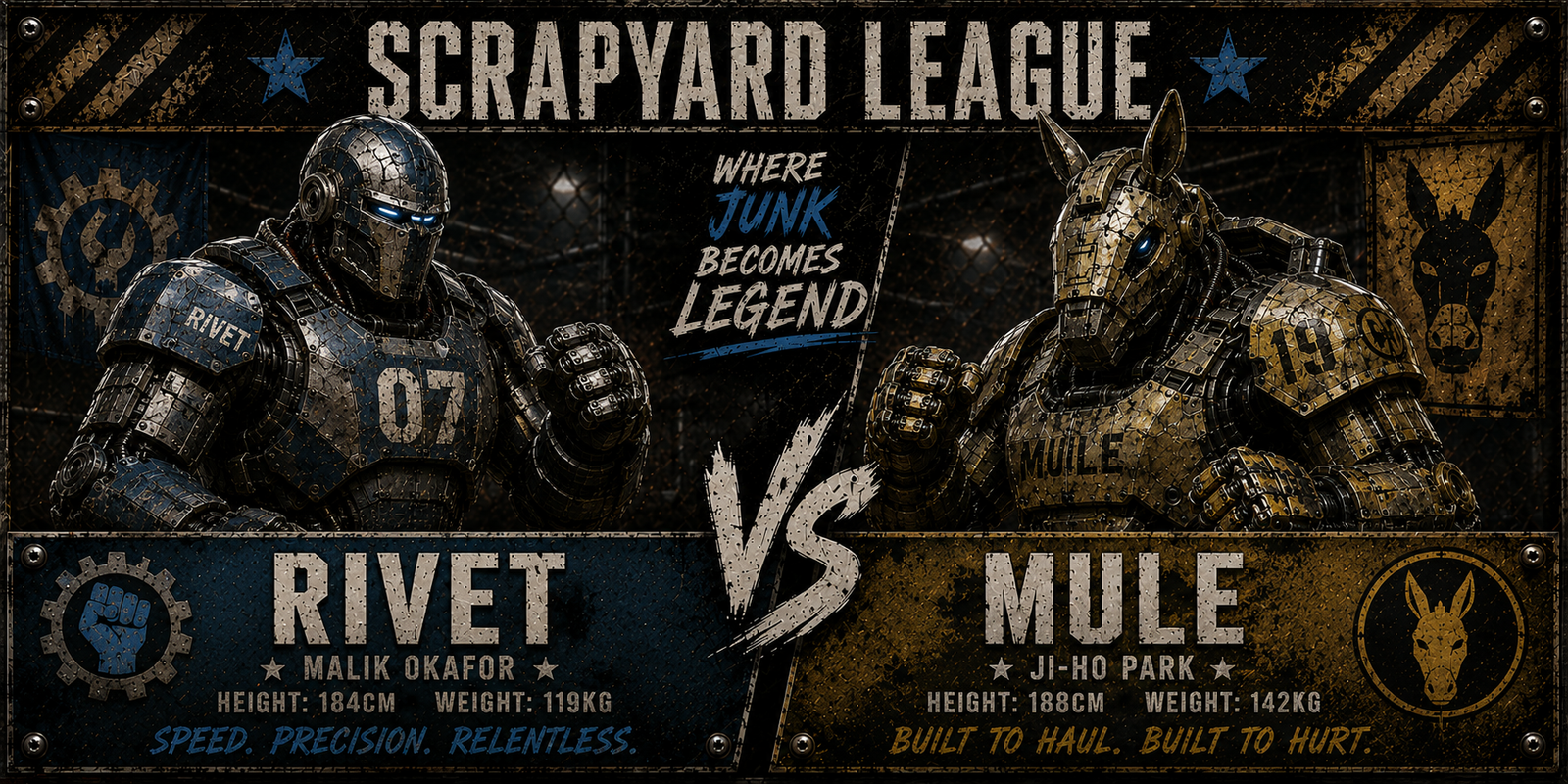
Mule’s second fight was against Rivet.
This time, Ji-ho acted earlier.
Mule controlled the opening Turn through clinch pressure, barrier control and Security Restraint.
It identified Rivet’s Heat problem and repeatedly prevented the faster machine from cooling.
Rivet reached more than double its normal Heat Limit and temporarily shut down after its final attack.
Mule had found the correct tactical solution.
It still lost.
Rivet repeatedly targeted Mule’s already damaged left arm and reduced it to Critical condition during the final exchange.
Rivet completed the decisive damaging action before its own systems failed, recovered before the referee count expired and won the decision, 29–28.
Mule immediately disengaged when the referee intervened.
It accepted the result without complaint.
“Rivet completed the damaging action before its systems failed. The result is valid.”
Ji-ho’s assessment was less comfortable.
“We found the correct pressure. We did not convert it into the result. That is the problem now.”
Mule has now lost two consecutive fights by a single Turn.
Its story is no longer simply about learning to act earlier.
Mule can recognise the right tactic, apply sustained pressure and push an opponent to mechanical failure.
It still struggles to convert that advantage into victory.
Ji-ho reinforced Mule’s damaged left arm rather than installing a more destructive weapon.
The decision preserved the robot’s identity but left the team with almost no financial reserve.
Their season now centres on one unresolved question:
How much aggression can Ji-ho demand before Mule believes it is being changed into something it was never built to be?
A future fight may place a damaged opponent directly in front of Mule.
The safe action will be restraint.
The winning action may be immediate destruction.
For the first time, Ji-ho may have to give the order without hesitation.
Mule will have to decide whether to follow it.
SUPPORT JI-HO AND MULE
Ji-ho and Mule are fighting to prove that stability, restraint and old industrial skill still have a place in the Scrap Yard League.
Support their campaign to follow:
- Mule’s attempt to earn its first victory;
- Ji-ho’s struggle to balance safety with competitive urgency;
- the team’s search for affordable industrial parts;
- Mule’s development from security machine to regulated fighter;
- the growing conflict between controlled force and the need to finish;
- their fight to remain operational in a city that has already declared them obsolete.
Mule does not promise spectacle.
Ji-ho does not promise reckless victories.
They promise to arrive prepared, remain standing and make every opponent prove that force alone is enough to move them.