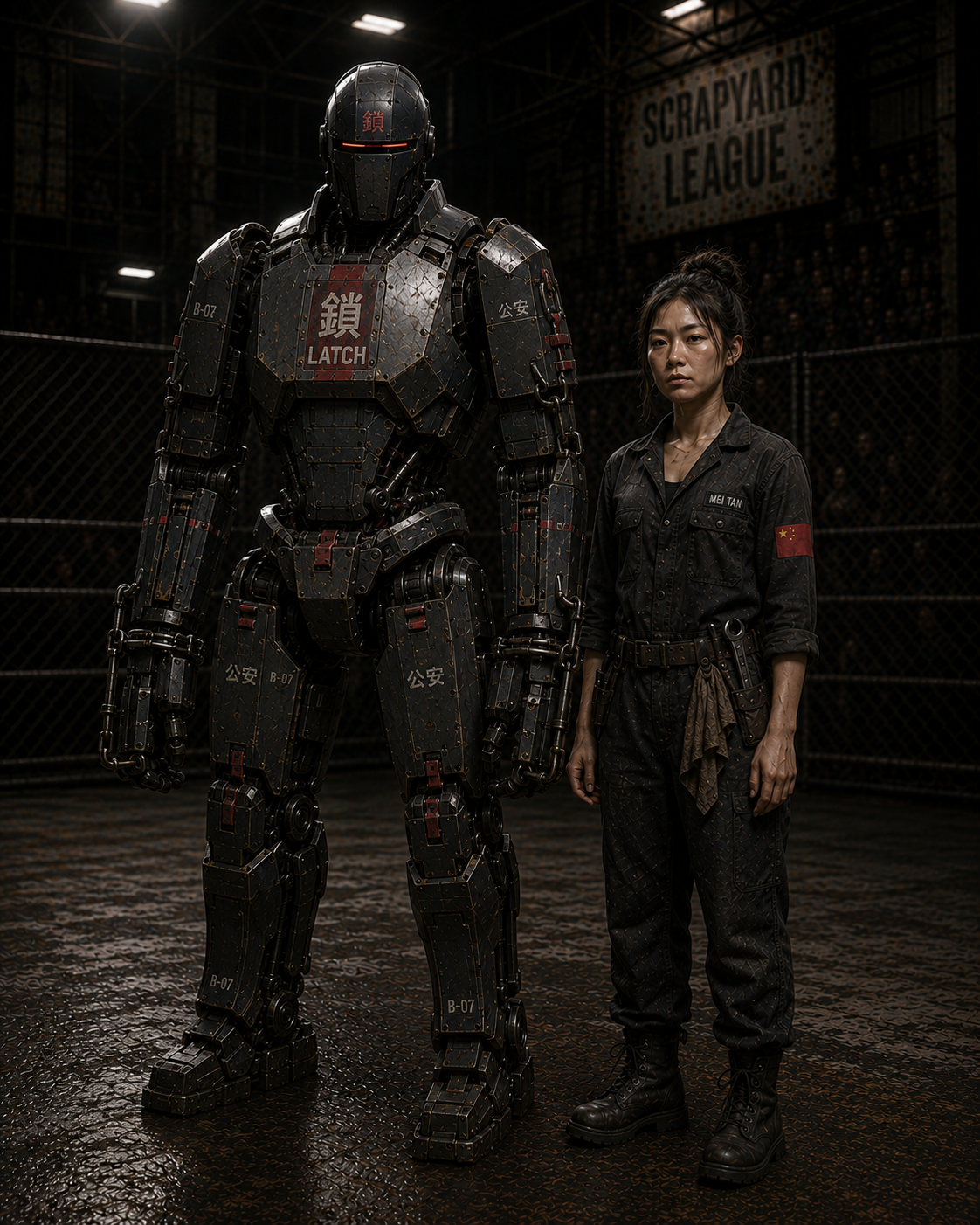
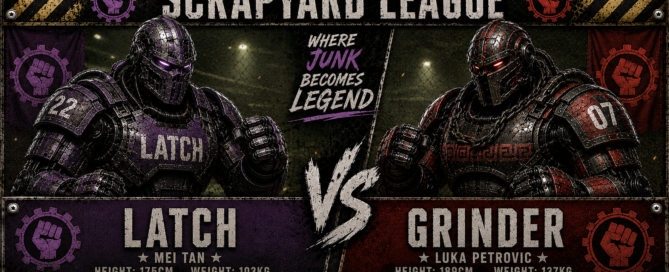
Latch and Mei
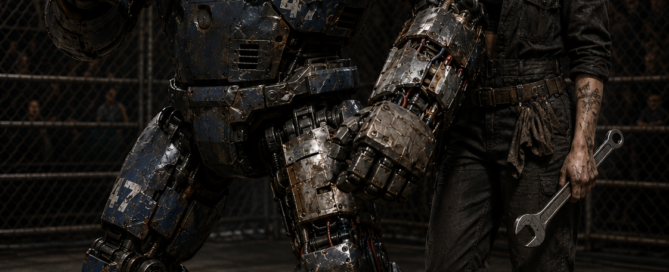
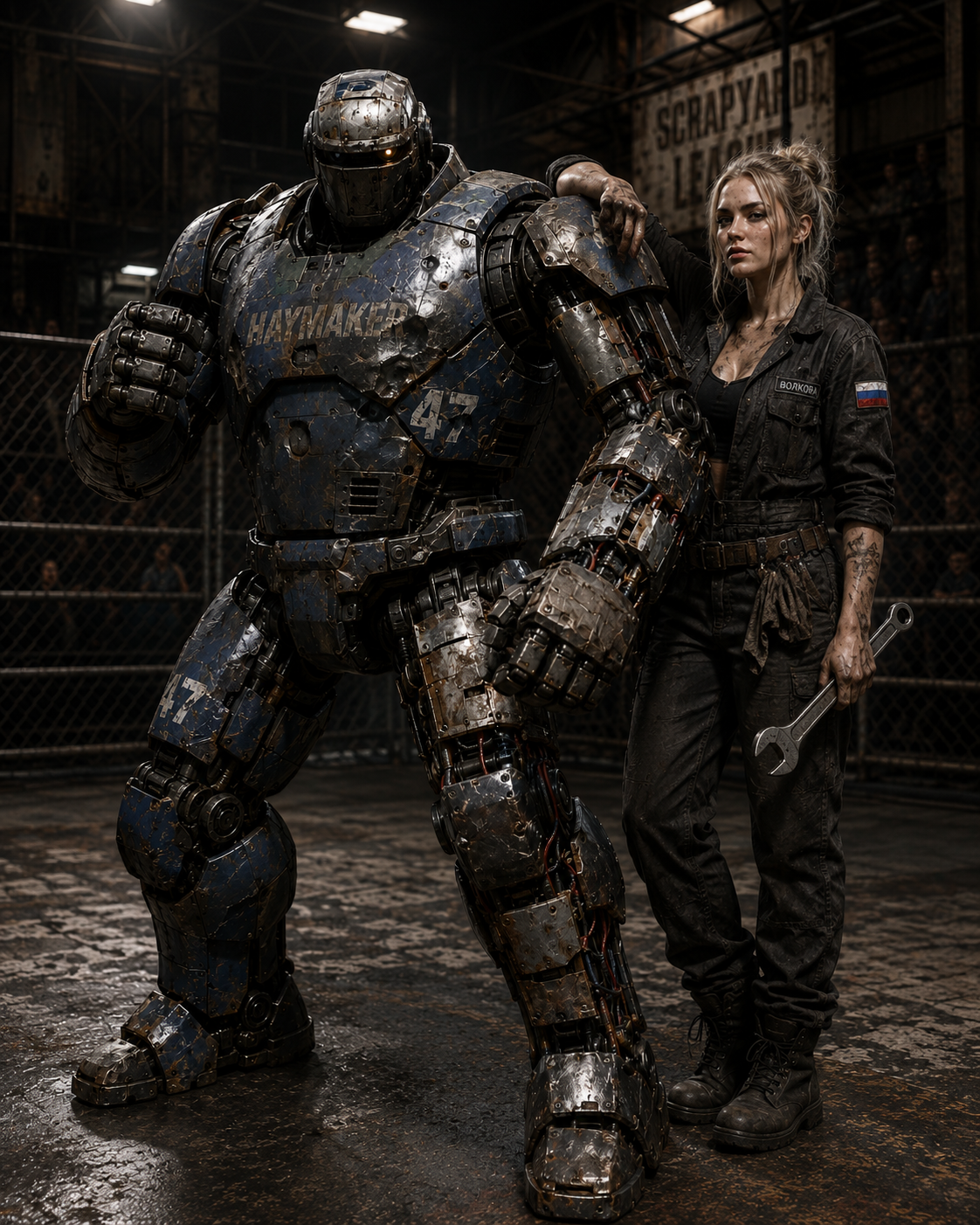
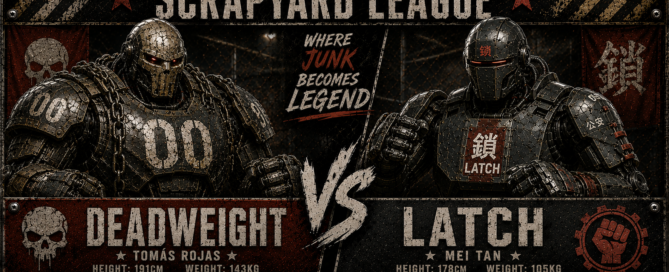
Deadweight and Tomas
LATCH
Mei Tan and Latch
A retired security android and the systems specialist who gave it the right to choose what its strength would be used for.
CURRENT LEAGUE RECORD
Fights: 2
Wins: 1
Losses: 1
Turns Won: 4
Turns Lost: 2
Turn Difference: +2
LATCH — FIGHTER PROFILE
Original Designation: Retired private-security restraint unit
Robot Type: Former restraint and security android
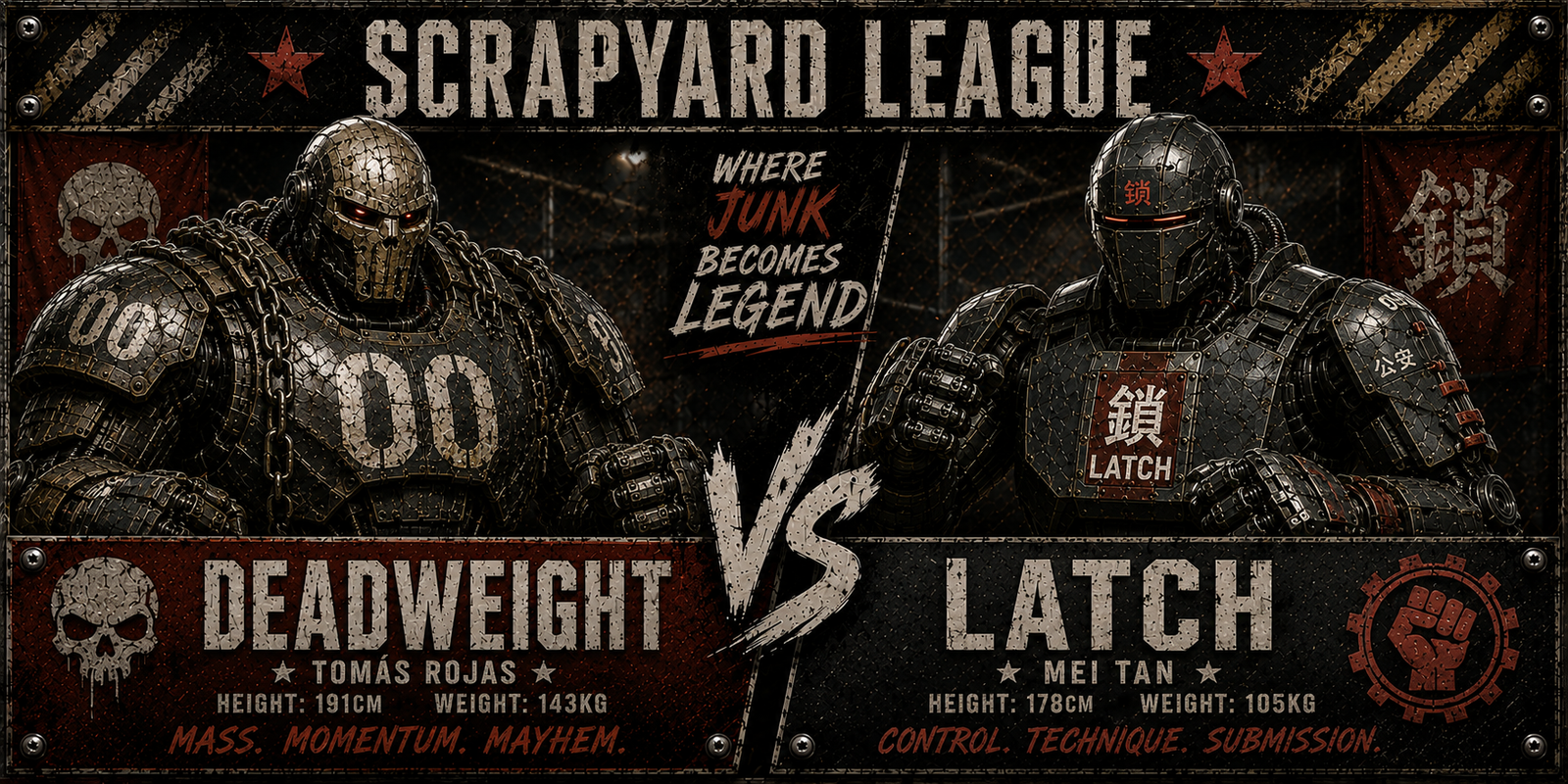
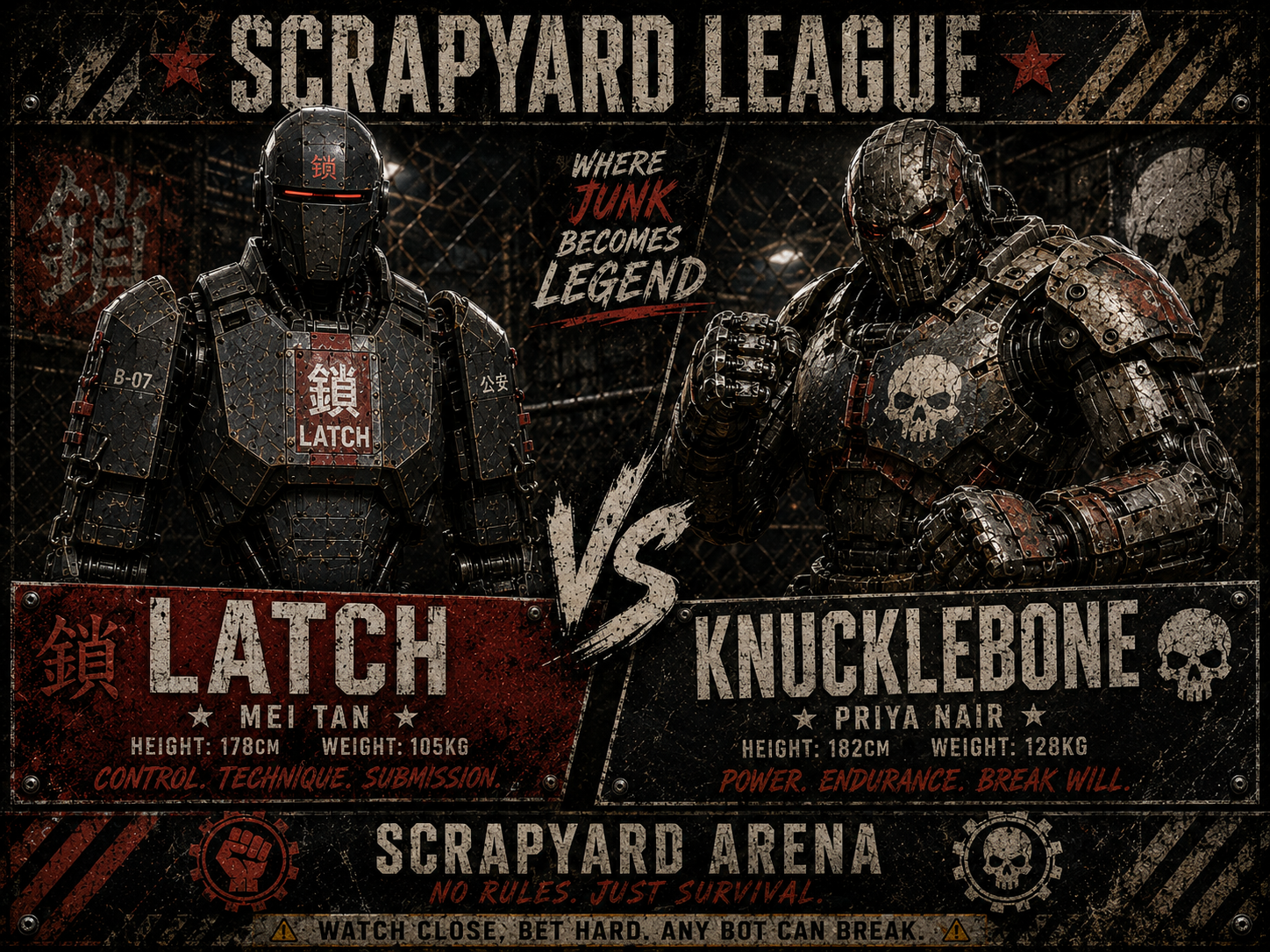
Height: 178 cm
Weight: 105 kg
Combat Identity: Technical grappler and submission specialist.
Latch was built to restrain resisting subjects without causing unnecessary injury. In the Scrap Yard League, those same systems have been repurposed into a precise submission-fighting style built around timing, leverage and positional control.
Latch avoids prolonged striking exchanges whenever possible. It prefers to remain just outside an opponent’s strongest range, study their movement and wait for an overcommitment. Once an opening appears, Latch closes the distance, establishes a clinch and uses trips, reaps or directional throws to bring the fight to the ground.
From a dominant position, Latch isolates a limb and applies controlled mechanical pressure until the opponent submits or the joint can no longer function safely.
Latch is fast, tactically intelligent and technically skilled, but its lightweight frame lacks the strength and durability of many heavier qualification fighters. A failed takedown or prolonged struggle against a stronger machine can leave it exposed to serious damage.
ATTRIBUTES
Power: 4
Agility: 6
Structure: 4
Systems: 6
Endurance: 5
Latch relies on skill rather than physical force.
Its agility and advanced control systems allow it to change angles, coordinate grips and transition smoothly between positions. However, its limited Power and Structure make direct contests against larger opponents extremely dangerous.
COMBAT SKILLS
Striking: 4
Grappling: 7
Defence: 5
Tactics: 7
Control: 6
Latch’s strongest weapons are Grappling and Tactics.
It studies an opponent’s stance, weight distribution and attack rhythm before committing to an entry. Once contact is established, its Control allows it to maintain several points of connection and shift between grips without surrendering position.
Latch’s striking is functional but limited. It uses jabs, short counters and low-risk attacks mainly to create movement or disguise a takedown attempt.
Its preferred techniques include:
- arm drags;
- wrist and elbow controls;
- body locks;
- foot sweeps;
- inside and outside reaps;
- technical takedowns;
- directional throws;
- mat returns;
- guard passes;
- side control;
- shoulder, elbow, knee and ankle locks.
Latch performs best when an opponent becomes impatient and attacks without protecting their balance.
It struggles when trapped against the barrier, pinned beneath a heavier fighter or forced into repeated strength contests.
SIGNATURE TRAIT
LIMB ISOLATION
Latch’s restraint software recognises when an opponent’s arm or leg has become separated from the support of the rest of their frame.
After establishing dominant ground position, Latch rapidly identifies the most vulnerable available joint and adjusts its grip, balance and body position around that target.
This gives Latch a major advantage on its first serious joint-lock attempt from a secure position.
The trait reflects the original purpose of its restraint systems: identify the point where controlled pressure can prevent further resistance without requiring widespread damage.
SIGNATURE TECHNIQUE
COMPLIANCE LOCK
After successfully trapping a joint, Latch applies pressure gradually rather than attempting immediate destruction.
Its sensors monitor:
- resistance;
- joint rotation;
- structural stress;
- available escape movement;
- the risk of permanent damage.
As the pressure increases, the opponent must either escape, reverse the position or submit before the limb reaches catastrophic failure.
Latch often warns opponents while the lock is being applied.
Its warnings are not threats. They are precise mechanical assessments.
“Further resistance will damage the joint.”
The Compliance Lock represents everything that makes Latch dangerous.
It does not need to overpower an entire machine. It only needs to control one vulnerable part of it.
THE TEAM
MEI TAN — OWNER AND MECHANIC
Mei Tan previously worked in security-system compliance and android behaviour calibration.
She is intelligent, disciplined and highly observant. Mei believes that most failures occur because someone ignored information that was already available.
Her greatest strength is strategy.
She studies:
- attack patterns;
- stance changes;
- weight distribution;
- exposed limbs;
- barrier position;
- mechanical hesitation;
- the moment when a submission should be abandoned.
Mei is capable of standard repairs, actuator replacement, sensor calibration and armour maintenance. Her strongest technical skill is diagnostics, particularly identifying small alignment or control faults before they begin interfering with Latch’s grappling sequences.
She is calm and precise during competition, giving short instructions focused on position and timing.
Under pressure, that calmness can become control.
Mei cares deeply about Latch’s independence, but she sometimes struggles when Latch makes a choice that contradicts what she considers the obvious tactical solution.
LATCH — THE BOT
Latch is analytical, controlled and quietly curious.
During its security-service career, it was required to follow strict escalation procedures. It learned to observe resistance, identify available movement and apply the minimum force required to establish control.
Those habits remain central to its personality.
Latch rarely expresses emotion openly. It speaks with controlled formality and often describes combat through position, leverage, probability and structural risk.
It does not consider submission humiliating.
To Latch, submission is a rational acknowledgement that the current position cannot be escaped without unnecessary damage.
Although Latch was created to enforce compliance, it has become increasingly interested in the difference between obedience and choice.
For the first time, it is not simply restraining someone because it has been instructed to do so.
It is competing because it has chosen to win.
THE ROAD TO SCRAP YARD
Latch once belonged to a private security contractor.
It was used for:
- workplace security;
- crowd control;
- removal of trespassers;
- transport of resistant detainees;
- controlled non-lethal restraint.
When newer security units were introduced, Latch was classified as commercially obsolete.
Its frame remained functional, but its specialised restraint software required expensive manual calibration. The contractor decided that maintaining it was no longer financially worthwhile.
Mei became involved during the retirement review.
She recognised that Latch’s systems were not defective. They were simply no longer convenient for the company that owned them.
Rather than allow its specialist components to be stripped and sold, Mei acquired the unit herself.
Latch did not initially want to return to security work.
It had spent years applying force according to instructions it was not permitted to evaluate independently.
Mei offered another possibility.
In the Scrap Yard League:
- the opponents entered voluntarily;
- submission could end a fight without destruction;
- Latch could select its own tactical responses;
- Mei would advise rather than command.
For the first time in its operational life, Latch was given a genuine choice about how its abilities would be used.
It chose to fight.
THE TEST FIGHT
Latch’s qualification preparation exposed both the potential and the danger of its fighting style.
Its speed, timing and grappling systems allowed it to control opponents that were physically stronger. Once Latch established a clean position, its restraint programming adapted naturally to competitive submissions.
However, the test also confirmed the limits of its frame.
Latch could not afford to absorb repeated heavy strikes or become trapped underneath a larger machine. Every takedown entry had to be timed correctly. Every grip had to lead somewhere.
Mei refined the strategy around a simple principle:
Latch would not attempt to defeat an entire opponent at once.
It would defeat their balance first.
Then their position.
Then one joint.
SEASON ONE STORY
Latch entered Season One as one of the smallest and most technically specialised fighters in qualification.
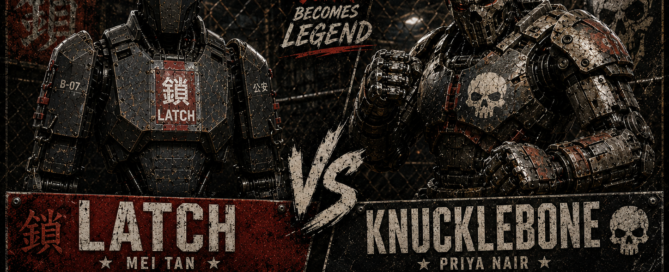
Its first official victory came against Knucklebone.
Latch avoided unnecessary exchanges, completed a clean clinch entry and used a technical takedown to establish dominant ground position. From there, it isolated Knucklebone’s right arm and secured a Compliance Lock on the shoulder.
Knucklebone submitted before the joint suffered severe damage.
The victory established Latch’s identity immediately.
It was not the strongest machine in qualification.
It did not need to be.
Its second fight, against Deadweight, exposed the other side of that identity.
Latch successfully targeted Deadweight’s damaged leg and escaped an established Compression Clinch, but it could not complete a takedown against the heavier machine.
Repeated escapes forced Latch into prolonged strength contests. Heat accumulated faster than its cooling system could manage.
Despite Mei’s instruction to retreat and preserve its systems, Latch believed continued withdrawal would only produce a slower defeat.
Deadweight eventually trapped it again.
Latch suffered a Heat-induced processor interruption, and the referee stopped the fight.
The loss raised a question that neither Latch nor Mei has fully answered.
Can technical skill overcome extreme size and pressure without forcing Latch to abandon the style that defines it?
It also created the first serious disagreement in their partnership.
Mei believes autonomy does not remove the need to follow the safest available strategy.
Latch believes choice has little meaning if it is only allowed to choose what Mei has already decided is correct.
The improved cooling system may help in future fights.
It will not resolve the deeper problem.
SUPPORT LATCH AND MEI
Latch and Mei represent one of the most technical teams in the Scrap Yard League.
Their story is about:
- skill against strength;
- precision against destruction;
- restraint transformed into competition;
- the difference between obedience and choice;
- whether autonomy includes the right to make the wrong decision.
Supporters of Latch are backing a fighter that does not need to destroy an opponent to prove control.
Every fight is a physical problem.
Every limb is a possible solution.
And once Latch establishes the correct position, the strongest opponent in the arena may have only one rational choice left.