Grinder and Luka
Grinder and Luka
GRINDER
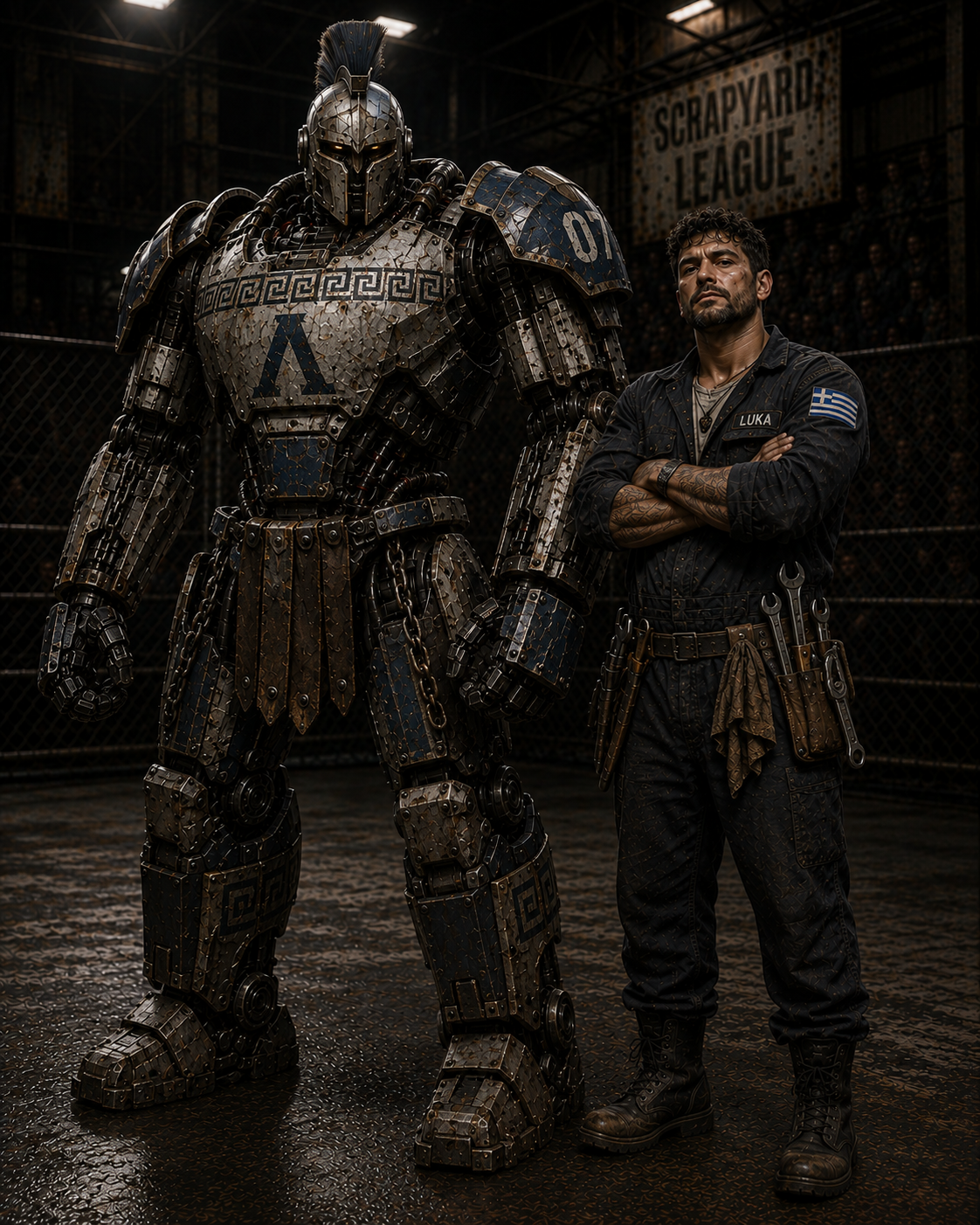
Luka Petrovic’s Demolition-Yard Crusher
Built from discarded machinery. Held together by stubbornness. Driven forward by the belief that anything can be broken if enough pressure is applied.
CURRENT LEAGUE RECORD
Wins: 1
Losses: 1
Draws: 0
Turns Won: 3
Turns Lost: 3
Decision Wins: 1
Knockout Wins: 0
Shutdown Wins: 0
Submission Wins: 0
Grinder opened its recognised fighting career with a narrow decision victory over Mule before losing an equally close decision to Tin Saint.
Both fights exposed the same truth.
Grinder is dangerous enough to defeat almost anyone at close range.
The problem is surviving what happens when it refuses to release them.
FIGHTER PROFILE
Fighter Name: Grinder
Owner and Mechanic: Luka Petrovic
Original Purpose: Salvaged demolition-yard fighting robot
Height: 189 centimetres
Weight: 137 kilograms
Fighting Style: Pressure fighter and clinch grappler
Grinder was never built as a single machine.
Its frame was assembled from discarded demolition equipment, industrial crushing machinery, reused armour, salvaged hydraulic systems and components taken from at least one former fighting robot.
The parts were not designed to work together.
Luka Petrovic made them work anyway.
Grinder enters every fight with the physical certainty of a machine that spent its previous life breaking things that could not fight back. It advances directly, accepts damage to close the distance and tries to secure an opponent before they can escape.
Once Grinder gains a strong clinch, the fight changes.
Its reinforced arms and demolition hydraulics begin forcing the opponent backwards, crushing exposed sections and testing every joint and mounting point for weakness.
Grinder is powerful, difficult to discourage and mechanically observant.
It is also impatient, vulnerable at distance and dangerously willing to continue after Heat and damage begin affecting its systems.
Grinder does not believe a fight is going badly while it can still move forward.
ATTRIBUTES
| Attribute | Rating |
|---|---|
| Power | 7 |
| Agility | 3 |
| Structure | 6 |
| Systems | 3 |
| Endurance | 4 |
Power — 7
Grinder’s greatest advantage is its raw physical strength.
Its arms, shoulders and torso were built around industrial force rather than speed or precision. Once it establishes contact, it can drive lighter opponents backwards and place enormous pressure through their frames.
Agility — 3
Grinder is slow and mechanically direct.
It struggles to chase mobile opponents, change direction quickly or respond to repeated attacks from different angles.
Its preferred solution is not to become faster.
It is to remove the opponent’s ability to move.
Structure — 6
Grinder’s body is reinforced and capable of enduring significant punishment.
Its salvaged construction gives it substantial physical resilience, although the use of mismatched systems means damage can create unexpected secondary failures.
Systems — 3
Grinder’s control systems are functional but crude.
Its incompatible components, improvised architecture and limited processing flexibility make subtle faults difficult to predict.
It performs best when the problem in front of it can be solved physically.
Endurance — 4
Grinder can continue through damage and system strain, but its aggressive fighting style places heavy demands on its cooling and hydraulic systems.
Its endurance is often limited less by courage than by Heat.
COMBAT SKILLS
| Combat Skill | Rating |
|---|---|
| Striking | 5 |
| Grappling | 6 |
| Defence | 3 |
| Tactics | 4 |
| Control | 5 |
Striking — 5
Grinder is a capable close-range striker.
Its punches are heavy and damaging, but they are used primarily to force reactions, close distance or create an opening for a clinch.
It is not designed for long-range exchanges with faster opponents.
Grappling — 6
Grappling is Grinder’s strongest developed combat skill.
It uses its weight, hydraulic force and reinforced frame to seize opponents, trap limbs and force them into positions where movement becomes increasingly difficult.
Defence — 3
Grinder’s defence is one of its clearest weaknesses.
It relies heavily on durability, forward pressure and the hope that the opponent will run out of room before Grinder runs out of Structure.
It is particularly vulnerable while approaching faster strikers.
Tactics — 4
Grinder understands direct combat problems well.
It can recognise damaged joints, unstable footing, weakening resistance and opportunities to increase pressure.
Its tactical weakness is patience.
Even when disengaging would be the correct decision, Grinder often believes that one more attack will finish the fight.
Control — 5
Grinder has enough balance and positioning ability to make its grappling dangerous.
It is especially effective when it can force an opponent against the barrier and use its full body weight to restrict escape.
SIGNATURE TRAIT AND SIGNATURE TECHNIQUE
Signature Trait: Crushing Drive
Grinder’s reinforced arms, shoulders and torso allow it to transmit exceptional force during sustained clinch pressure.
Once Grinder establishes a legitimate dominant clinch, it can drive through an opponent’s frame with more force than its ordinary attacks would suggest.
Crushing Drive is most effective when:
- Grinder has established firm control;
- at least one arm remains fully functional;
- its legs have secure footing;
- Heat has not disrupted its power transmission;
- the opponent has limited room to escape.
The trait makes Grinder one of the league’s most dangerous close-range fighters.
It also encourages Grinder to remain in high-output clinches for longer than its cooling systems can safely support.
Signature Technique: Demolition Clamp
Grinder locks its arms around an opponent’s torso or trapped limb and applies sustained inward pressure through its demolition-yard hydraulic systems.
The technique is not elegant.
Grinder secures the position, tightens its grip and continues applying force until:
- the opponent escapes;
- a joint begins to fail;
- the frame starts to buckle;
- Grinder’s own systems can no longer maintain pressure.
When Demolition Clamp is established cleanly, Grinder can damage the opponent while keeping it trapped inside the clinch.
The technique represents everything that makes Grinder dangerous.
It also represents everything that makes Grinder vulnerable.
Grinder does not like releasing something that has begun to break.
THE TEAM
LUKA PETROVIC — OWNER, MECHANIC AND CORNER SUPPORT
Luka Petrovic is a Greek working-class salvage mechanic with a talent for forcing incompatible machinery to work together.
He is practical, resourceful, expressive and fiercely proud of what he can build with limited money and unwanted parts.
Luka believes proven ability matters more than formal qualifications. He respects people who understand their machinery and has little patience for anyone who assumes expensive equipment automatically means superior skill.
His Myers-Briggs personality type is:
ESTP — Extraverted, Sensing, Thinking and Perceiving
Luka is at his best when something has already gone wrong.
He reacts quickly, trusts physical evidence and is comfortable making immediate decisions under pressure. When a component fails, Luka does not spend long discussing what should have happened. He opens the housing and begins working.
He is particularly capable with:
- heavy structural repairs;
- welding and fabrication;
- hydraulic systems;
- reinforced joints;
- actuator replacement;
- improvised armour;
- adapting industrial components for combat.
He is less comfortable with advanced software, complex electronics and intermittent control faults that cannot be easily seen or physically tested.
Luka’s Greek background influences his understanding of family, responsibility and loyalty without defining his entire personality.
He treats belonging as an obligation expressed through action.
Care means arriving when someone needs help, repairing what is broken, sharing what he can afford and becoming angry when someone he values takes an unnecessary risk.
He may argue fiercely with relatives or friends while remaining completely prepared to help them.
Luka does not usually explain affection directly.
He fixes things.
He shows up.
He refuses to abandon people or machines after they become difficult.
This is the foundation of his relationship with Grinder.
It is also part of their problem.
Luka is highly willing to gamble on his own work. He trusts his ability to improvise and can mistake confidence for control.
He and Grinder often encourage one another to continue when a calmer team would disengage.
In public, Luka is confident and confrontational. He enjoys defending Grinder, challenging analysts and presenting himself as the salvage mechanic competing against better-funded teams.
Critics see him as reckless.
Supporters see someone refusing to let wealth determine who deserves a place in the league.
GRINDER — THE DEMOLITION-YARD CRUSHER
Grinder is intense, impatient and physically direct.
It understands the world through:
- pressure;
- resistance;
- movement;
- structural sound;
- mechanical failure.
To Grinder, most things are either holding, slipping, cracking or broken.
This does not make it unintelligent.
Grinder is highly observant when reading another machine’s physical condition. It notices damaged joints, changes in balance, unstable frames and declining resistance.
It simply distrusts unnecessary complexity.
Grinder speaks in short, concrete statements. It rarely uses elaborate explanations and is not naturally humorous, although its literal comments may sound dry or threatening.
It takes pride in:
- its Power;
- surviving despite its salvaged construction;
- forcing opponents backwards;
- making refined machines panic at close range;
- proving that discarded machinery can remain dangerous.
Grinder reacts badly when called crude, defective, unintelligent or scrap.
It knows it was never built perfectly.
Its pride comes from the fact that it continued functioning when other people expected it to be dismantled.
Grinder is loyal to Luka and highly sensitive to insults directed at him.
Luka is the person who repeatedly repaired Grinder after losses when previous handlers would have stripped it for useful components.
For Grinder, that decision carries more meaning than an emotional speech ever could.
THEIR PARTNERSHIP
Luka initially repaired Grinder for unofficial demolition-yard fights.
Those contests brought money, replacement parts and recognition among workers who understood what it took to keep damaged machinery operating.
Unlike Grinder’s previous handlers, Luka repaired it after defeat.
He did not remove the most valuable parts and discard the rest.
Over time, their arrangement became a partnership built on:
- repeated fights;
- emergency repairs;
- financial dependence;
- practical trust;
- shared aggression;
- refusal to accept that Grinder should have been scrapped.
Luka sees Grinder as proof that discarded machinery can become valuable and dangerous again.
Grinder sees Luka as the person who gave its mismatched systems a single purpose.
Their loyalty is extremely strong.
Their respect for one another is equally strong.
Their central weakness is that they reinforce each other’s worst instincts.
Grinder believes one more attack may break the opponent.
Luka often believes Grinder is right.
Neither is naturally inclined to stop while victory still appears physically possible.
THE ROAD TO SCRAP YARD
Grinder’s path to the league began in a demolition yard.
Damaged machines were dismantled there, compacted for scrap or placed into unofficial fights for the entertainment of workers.
Grinder had no clean manufacturing history.
Its body had been rebuilt repeatedly from whatever parts were available. Different systems operated at different tolerances. Repairs solved one problem while sometimes creating another.
Most professional mechanics would have considered the machine unreliable and uneconomical.
Luka saw potential.
He reinforced Grinder’s frame, repaired its hydraulic systems and adapted industrial parts for combat use.
Their early fights were rough, poorly regulated and practical.
Winning meant money.
Money meant parts.
Parts meant Grinder remained operational.
Those contests shaped both of them.
Grinder learned that relentless pressure could make more advanced machines panic.
Luka learned that a dangerous repair completed quickly could be more valuable than a perfect repair completed too late.
The approach worked well enough to earn local recognition.
It also created habits that would become much more dangerous under official league conditions.
When Scrap Yard offered a path into recognised competition, Luka did not see an opportunity merely to win fights.
He saw a chance to prove that Grinder belonged beside purpose-built machines.
Grinder reached the same conclusion more directly.
There would be opponents.
It intended to break them.
THE TEST FIGHT
Grinder’s test fight confirmed almost everything Luka wanted to believe.
The opponent could not withstand Grinder’s physical pressure.
Once Grinder closed the distance and established control, the fight became a demonstration of what its salvaged demolition systems could do to a combat frame.
The victory proved that Grinder possessed legitimate competitive power.
It also created a dangerous false assumption.
Luka and Grinder came away believing aggression could solve the problems created by Grinder’s poor cooling.
The test opponent had failed before Grinder’s systems did.
That did not mean the systems were reliable.
It meant the fight ended quickly enough for the weakness to remain hidden.
Grinder entered official competition believing that if it applied enough pressure, cooling would become the opponent’s problem rather than its own.
SEASON ONE STORY
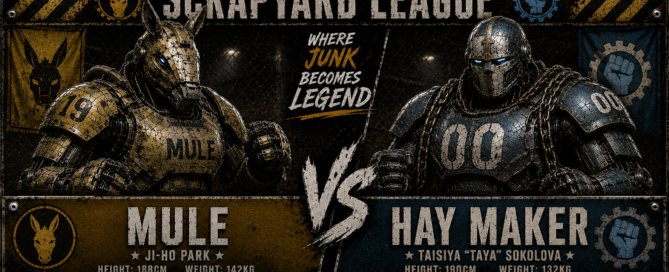
Grinder Versus Mule
Grinder’s first recognised fight was against Mule.
The match became a contest between Grinder’s crushing aggression and Mule’s extraordinary durability.
Grinder controlled the opening two Turns.
It forced Mule into close-range exchanges, applied Demolition Clamp and inflicted significant damage through sustained clinch pressure.
Mule remained standing.
Grinder continued increasing its output.
Its Heat reached 20—twice its safe Heat Limit.
Hydraulic delays developed, but Grinder remained operational long enough to secure a 29–28 decision victory.
The win appeared to prove Luka and Grinder correct.
Grinder could push beyond its safe limits and still win.
Mule’s late success should have served as a warning.
Instead, Grinder saw survival as validation.
After the fight, Luka made the largest mechanical investment of the team’s campaign.
He spent 7,500 credits on a complete cooling redesign.
The incompatible coolant-routing and fan network was removed and replaced. Grinder’s chronic Cooling Vibration was eliminated, and its cooling improved from Bad to Average.
Luka had solved a major mechanical weakness.
The question was whether Grinder would use the improvement responsibly.
Grinder Versus Tin Saint
The answer came against Tin Saint.
Grinder again found success through pressure and physical aggression.
The new cooling system worked more reliably than the original network.
Grinder responded by pushing even harder.
Its Heat reached 24.
The effects became severe.
Actuators stalled. Processor interruptions disrupted its responses. Its legs failed to maintain stability, and Grinder repeatedly collapsed while Tin Saint remained functional.
The cooling redesign had not failed.
Grinder had treated improved reliability as permission to ignore every warning for longer.
Tin Saint won the deciding Turn and took the fight by decision, 29–28.
The loss left Grinder carrying significant damage.
Luka spent almost the entire fight prize restoring Grinder’s damaged right leg, leaving the team with only 500 credits and insufficient funds to complete every remaining repair.
Grinder’s head, torso and right leg continue to carry damage.
The head damage is particularly concerning because intermittent processor faults may be difficult for Luka to diagnose with his available equipment.
The team’s Season One story has now taken shape:
The cooling system was repaired. The recklessness was not.
Grinder remains powerful enough to threaten any opponent it can catch.
Luka remains skilled enough to keep a machine built from incompatible salvage competitive.
Neither has yet accepted that knowing when to stop may be as important as knowing how to continue.
WHAT COMES NEXT
Grinder’s future depends on more than repairing damaged Structure.
The team must confront several questions:
- Can Grinder learn to release a dominant clinch before Heat destroys its advantage?
- Can Luka give a cautious instruction without feeling that he is surrendering?
- Can they afford to keep entering fights with unresolved damage?
- How much of Grinder can be replaced before an upgrade begins to feel like erasing its identity?
- Can a machine built around relentless pressure develop patience?
- Can Luka learn that preparation strengthens improvisation rather than replacing it?
Grinder does not need to become gentle.
Luka does not need to become cautious by nature.
They need to understand that restraint is not the opposite of aggression.
Used correctly, restraint allows aggression to remain available when it matters.
SUPPORT GRINDER AND LUKA
Grinder and Luka represent every worker, mechanic and discarded machine that has ever been told it does not belong beside newer and wealthier competition.
Support from fans helps the team:
- repair carried damage;
- replace unreliable salvage components;
- improve Grinder’s cooling and control systems;
- prepare for future opponents;
- keep one of Scrap Yard’s most dangerous pressure fighters operational.
Grinder does not promise clean victories.
Luka does not promise sensible decisions.
They promise that every opponent will know it has been in a fight.
Support the demolition-yard crusher.
Help Luka keep Grinder fighting.