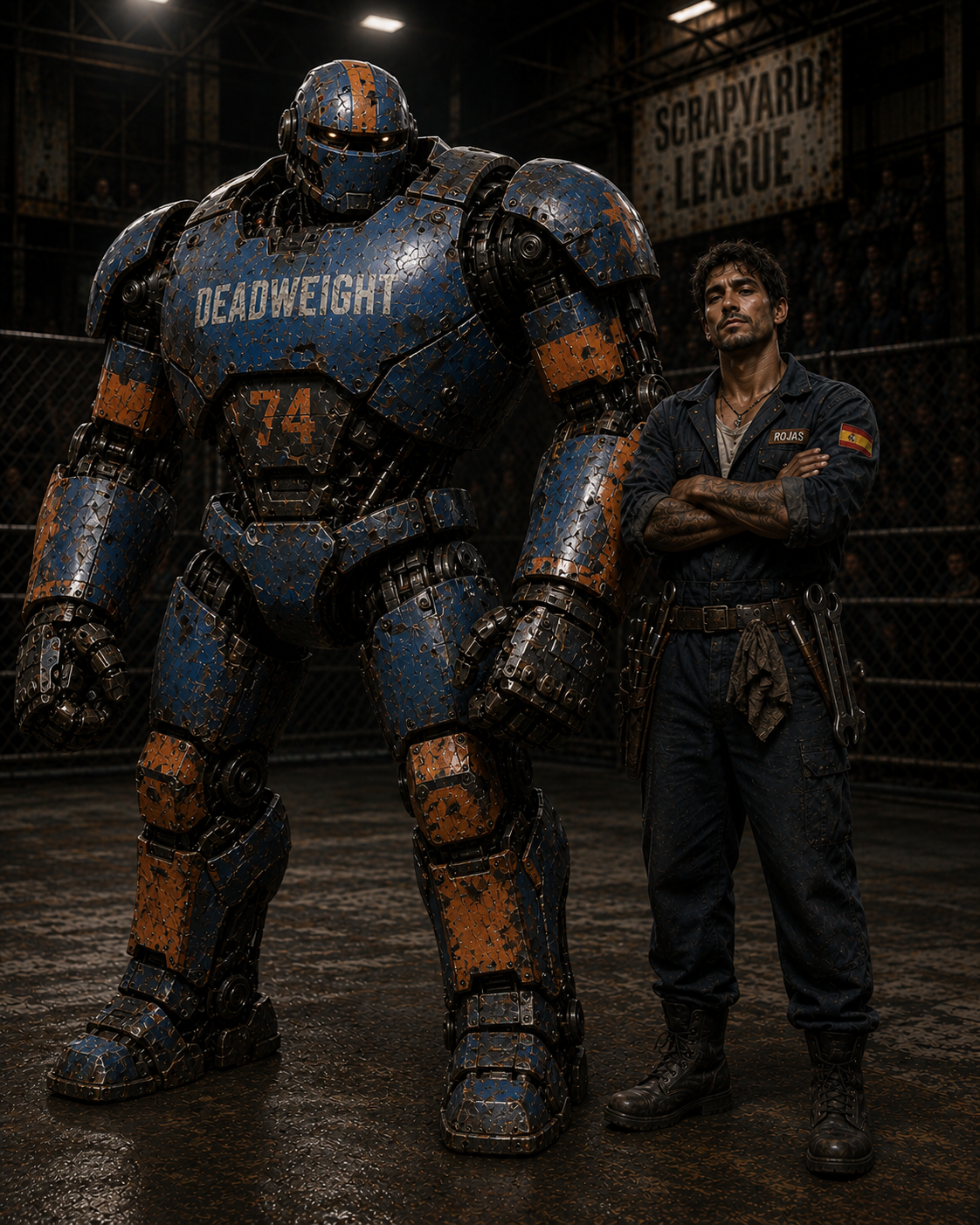
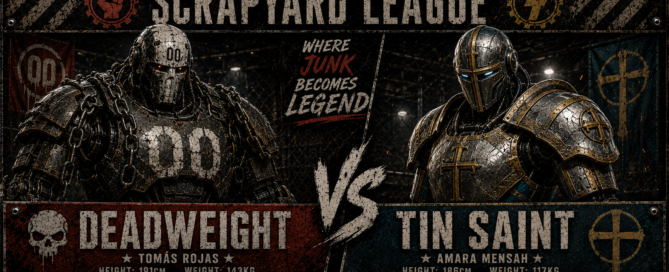
Deadweight and Tomas
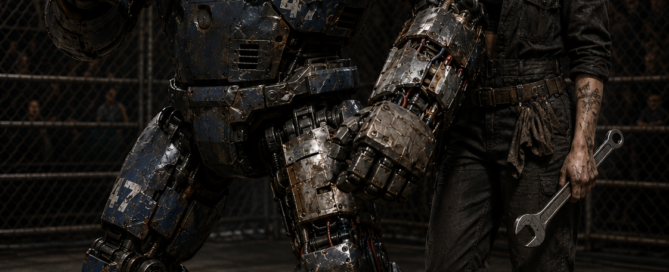
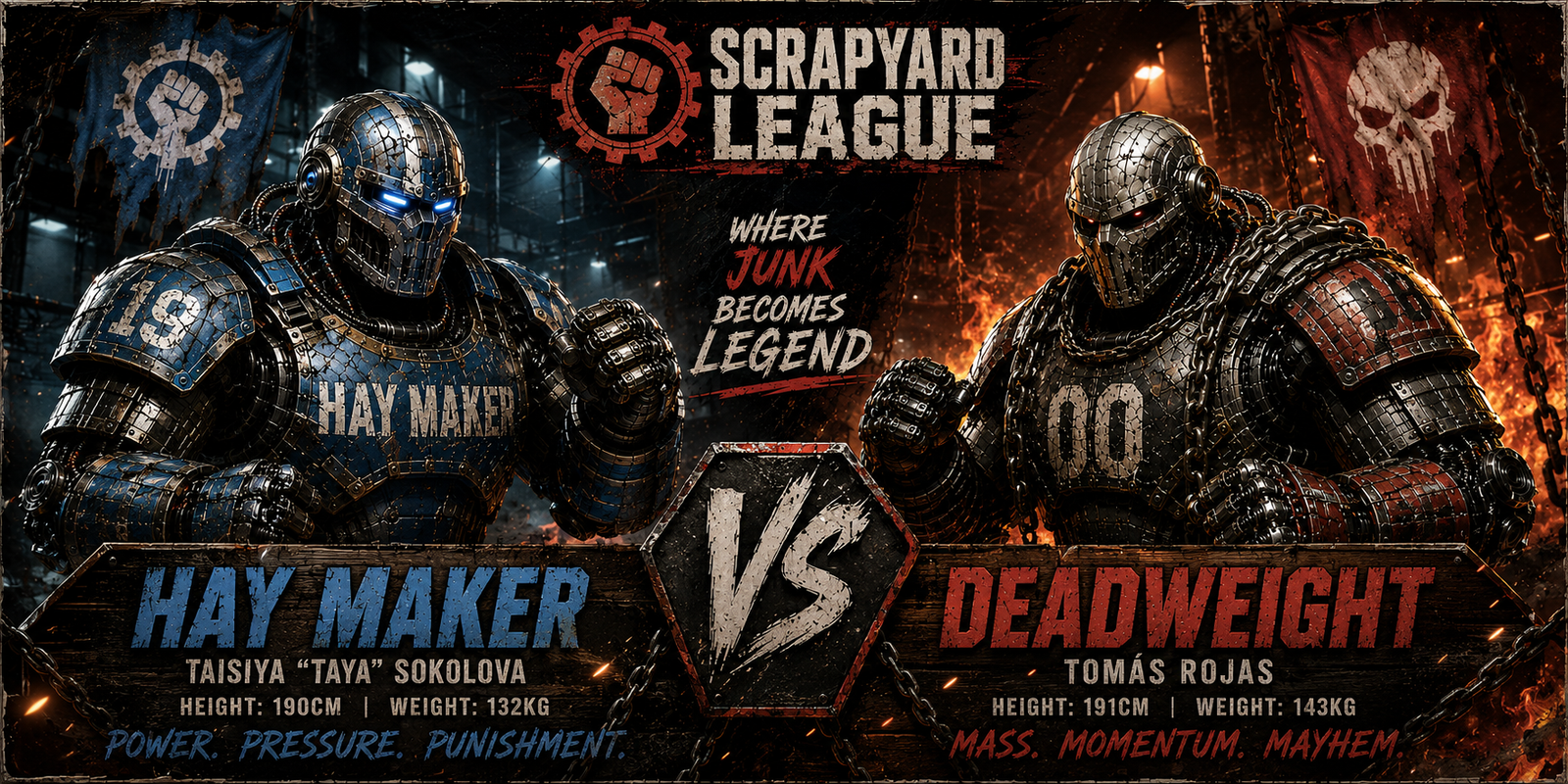
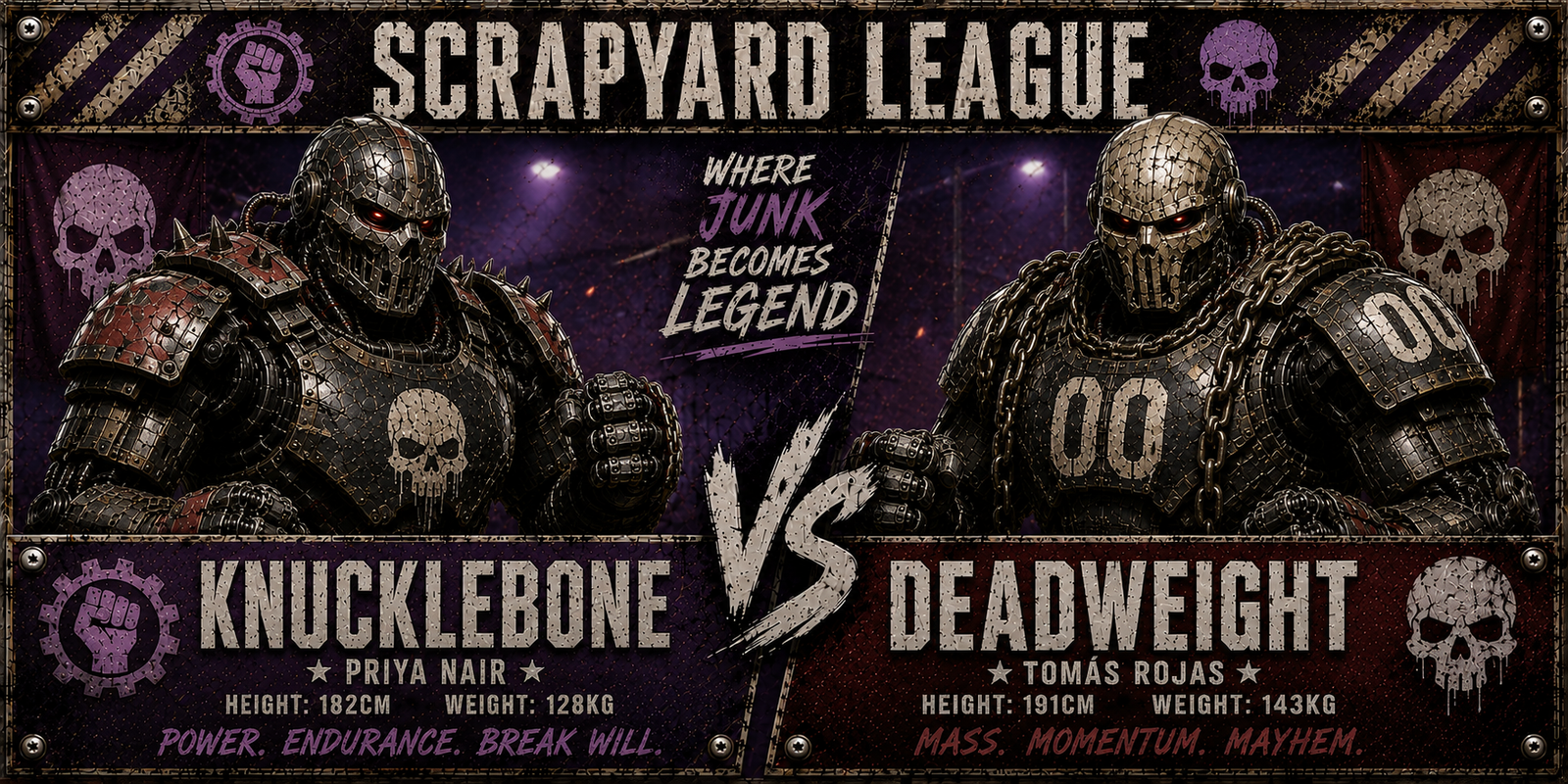
Deadweight and Tomas
DEADWEIGHT
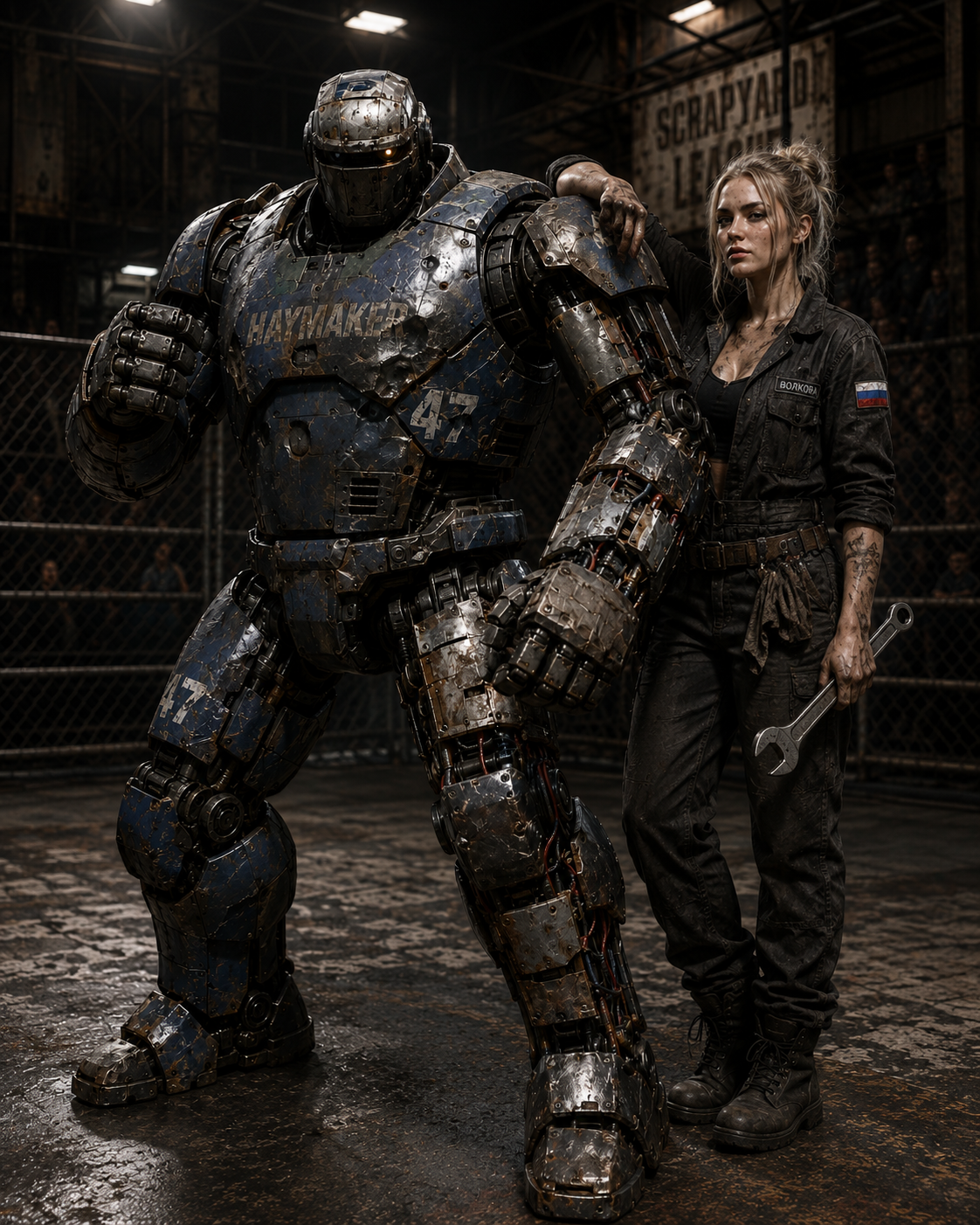
Tomás Rojas and Deadweight
An obsolete exhibition giant and the working mechanic who refused to let him become another machine discarded when the show ended.
CURRENT LEAGUE RECORD
Fights: 2
Wins: 1
Losses: 1
Turns Won: 3
Turns Lost: 3
Turn Difference: 0
DEADWEIGHT — FIGHTER PROFILE
Original Designation: No longer used
Robot Type: Obsolete heavy exhibition fighter
Height: 193 cm
Weight: 149 kg
Combat Identity: Immovable defensive grappler and pressure specialist.
Deadweight does not win through speed, combinations or relentless pursuit.
He establishes a position, waits for an opponent to enter his reach and makes leaving increasingly difficult.
His reinforced frame, enormous mass and stable stance allow him to absorb attacks that would force lighter machines backwards. Once he secures a clinch, he uses body positioning, barrier control and sustained pressure to exhaust opponents before attempting a controlled takedown.
Deadweight is at his most dangerous when an opponent tries to fight directly through him.
His preferred route to victory is to catch an aggressive entry, establish dominant clinch control and force the opposing machine to carry or resist his full weight. From there, he can damage limbs, compress the torso or bring the opponent down into top control.
He is exceptionally durable and difficult to move when properly braced, but his size creates serious limitations.
Deadweight is slow, struggles to change direction and cannot afford to waste energy chasing mobile opponents. If knocked down, his obsolete hip actuators and balance systems make returning to his feet extremely difficult.
Every fight therefore becomes a contest over one question:
Can the opponent stay away from Deadweight long enough to dismantle him—or will he eventually get hold of them?
ATTRIBUTES
Power: 7
Agility: 3
Structure: 7
Systems: 3
Endurance: 4
Deadweight possesses high physical strength and one of the most durable frames in qualification.
His Power and Structure allow him to absorb punishment, control clinches and apply enormous pressure once he establishes contact.
His greatest limitation is Agility.
Deadweight cannot pursue fast opponents effectively, recover quickly from missed movements or respond easily to repeated changes of angle. His outdated electronic systems can also struggle against complex targeting, disruption or highly adaptive opponents.
COMBAT SKILLS
Striking: 4
Grappling: 6
Defence: 5
Tactics: 4
Control: 5
Deadweight is an experienced and capable grappler.
His technique is built around underhooks, body locks, barrier pins, short throws and sustained top pressure rather than explosive wrestling.
His Defence relies heavily on armour, positioning and accepting limited damage in exchange for opportunities to secure contact.
Although he is not a sophisticated tactical fighter, Deadweight understands his own strengths. He knows when to brace, when to stop pursuing and when an opponent is spending too much energy trying to move him.
His Control allows him to manage his enormous frame effectively while standing or applying pressure in a known direction.
That control becomes far less reliable during scrambles, sudden turns or attempts to recover from the ground.
SIGNATURE TRAIT — DEAD LOAD
Deadweight locks his stance, lowers his centre of mass and turns his entire frame into a stabilised weight.
When properly braced, he becomes exceptionally difficult to lift, throw or take down through ordinary wrestling.
Dead Load works best when both legs remain functional, Deadweight has stable footing and he can see the attack coming.
It does not make him impossible to knock down.
Accumulated leg damage, lost balance, damaged footing or a specialised lifting technique can still bring the giant to the floor.
Once Deadweight is grounded, the same mass that protects him becomes one of his greatest weaknesses.
SIGNATURE TECHNIQUE — COMPRESSION CLINCH
Once Deadweight establishes dominant clinch control, he pulls the opponent into his broad frame and begins compressing them with his arms, torso and full body weight.
The technique is not a single explosive attack.
It is sustained mechanical pressure.
Deadweight traps the opposing machine against himself or the arena barrier, damages its torso and limbs and forces it to spend energy attempting to escape.
The longer the position lasts, the more dangerous it becomes.
Compression Clinch requires stable footing, functional arms and complete control of the opponent’s position. If Deadweight loses his stance or fails to secure the clinch properly, the technique cannot be applied.
THE TEAM
TOMÁS ROJAS — OWNER AND MECHANIC
Tomás Rojas is a practical heavy-machinery mechanic with years of experience keeping old equipment operational long after its manufacturers stopped supporting it.
He specialises in reinforced frames, structural repairs, hydraulics, large actuators and workshop fabrication.
Tomás is not an elite software engineer or advanced systems specialist. His strength lies in understanding how heavy machinery behaves under real pressure and finding practical solutions when official replacement parts are unavailable or unaffordable.
He is financially cautious, sceptical of promises and deeply uncomfortable with waste.
Tomás has spent much of his working life repairing machines that employers considered cheaper to discard than maintain. That experience shaped both his relationship with Deadweight and his attitude toward the Scrap Yard League.
He does not see Deadweight as a miracle, a monster or a symbol.
He sees him as a working machine that has kept every commitment asked of him.
Tomás expresses loyalty through maintenance rather than speeches. He checks joints, reinforces welds and searches salvage markets for components that no longer exist in official catalogues.
During fights, his advice is simple:
Stop chasing.
Protect the legs.
Set the stance.
Let the opponent come.
Make them carry the weight.
DEADWEIGHT — THE BOT
Deadweight is patient, stubborn and understated.
He spent much of his existence being presented to crowds as an unstoppable brute, despite knowing that many of his exhibition fights had predetermined outcomes.
Promoters called him a monster, a wall and a mindless machine.
Deadweight considers himself dependable.
He speaks slowly, pauses before answering and rarely uses more words than necessary. He does not make dramatic threats or perform for the audience.
When Deadweight says he intends to hold a position, he usually means that someone will have to break him to make him leave it.
He takes pride in his durability, his stability and his refusal to be discarded.
Deadweight is not easily provoked, but he dislikes being treated as stupid, obsolete or incapable of legitimate competition.
He has little interest in applause.
After years of staged entertainment, Deadweight understands that crowd reactions can be manufactured.
What matters to him now is whether the fight itself is real.
THE ROAD TO SCRAP YARD
Deadweight was originally built for a travelling robot exhibition circuit.
His role was to absorb spectacular attacks, appear impossible to move and throw smaller machines into padded barriers.
Some nights he was booked to win.
Other nights he was expected to lose.
The result depended less on performance than on what the promoters believed would entertain the crowd.
Tomás joined the exhibition company as a junior maintenance worker.
The company operated with limited parts, ageing machines and increasingly inadequate repair budgets. Tomás learned to keep oversized frames functioning with refurbished components, improvised fittings and long hours in temporary workshops.
Deadweight was one of the machines assigned to him.
Their partnership began as routine maintenance.
Over time, Tomás became the person most familiar with Deadweight’s obsolete systems, while Deadweight learned that Tomás would tell him the truth about damage, risk and the likelihood of returning to the arena.
When the exhibition company collapsed, its owners disappeared owing wages to much of the remaining staff.
Most of the machines were sold for scrap.
Tomás received Deadweight as partial payment for the money he was owed.
The arrangement was supposed to settle a debt.
Instead, it began the longest working partnership of Tomás’s life.
For several years, Deadweight worked outside combat.
He lifted machinery, moved workshop equipment, provided security and assisted Tomás with heavy industrial jobs.
Neither expected him to fight again.
But maintaining a 149-kilogram obsolete machine became increasingly expensive. Replacement parts were scarce, legitimate work was unreliable and Deadweight’s ageing systems required more attention every year.
The Scrap Yard League offered prize money, regulated access to parts and a chance to prove that Deadweight was more than an abandoned exhibition prop.
Tomás did not enter because he believed the League would make them famous.
He entered because keeping Deadweight operational required options they no longer had.
THE TEST FIGHT
Deadweight entered qualification carrying the reputation of a machine built for staged entertainment rather than legitimate competition.
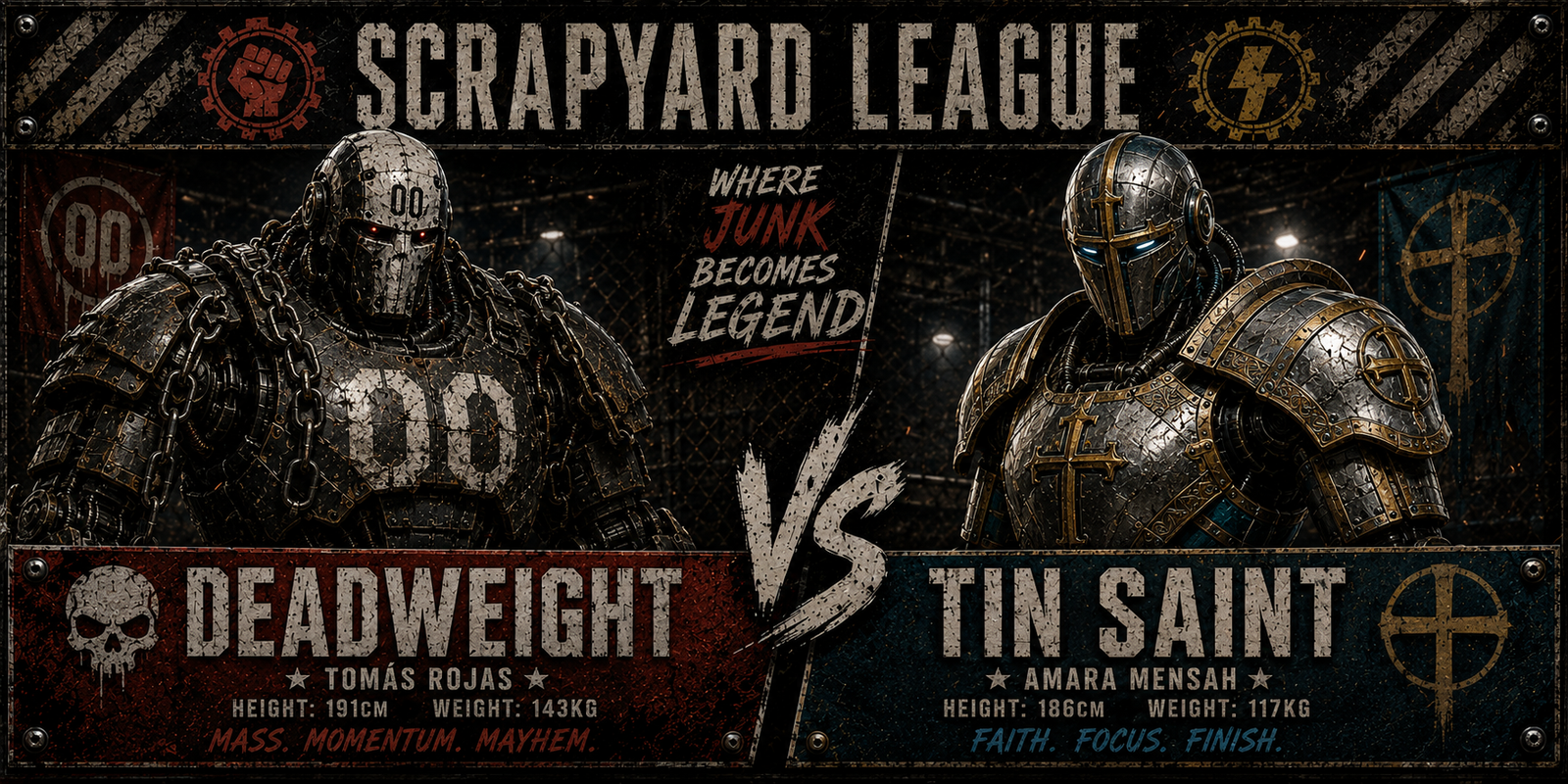
His opponent was Tin Saint.
The fight exposed both his strengths and his weaknesses.
Deadweight repeatedly established dominant clinches, used Compression Clinch successfully and completed the fight’s only takedown.
He won the second Turn and proved that his grappling could function against a genuine opponent.
But Tin Saint targeted his legs, forced him to move and pushed his ageing cooling systems beyond their limits.
By the final Turn, Deadweight’s Heat had risen dangerously high.
Tin Saint damaged his legs, knocked him down and left him unable to regain his feet before the signal.
Deadweight lost by judges’ decision.
He did not blame the judges, his age or the rules.
Tin Saint had identified the correct strategy and executed it.
The defeat proved Deadweight belonged in legitimate competition.
It also showed exactly how another opponent could beat him.
After the fight, Tomás faced a difficult decision.
Deadweight’s legs were damaged, but repairing them immediately would not solve the overheating that had undermined the entire performance.
Tomás spent heavily to replace and redesign Deadweight’s obsolete cooling network.
The choice meant carrying leg damage into the next fight.
It also meant betting nearly everything on the belief that Deadweight could survive long enough to make the upgrade worthwhile.
SEASON ONE STORY
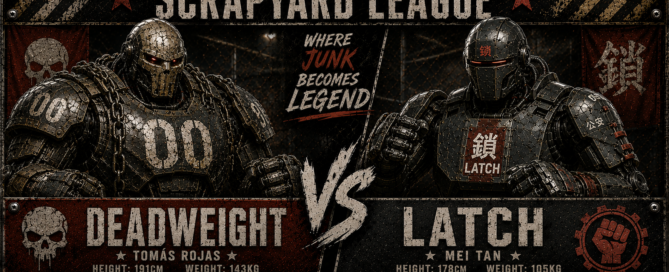
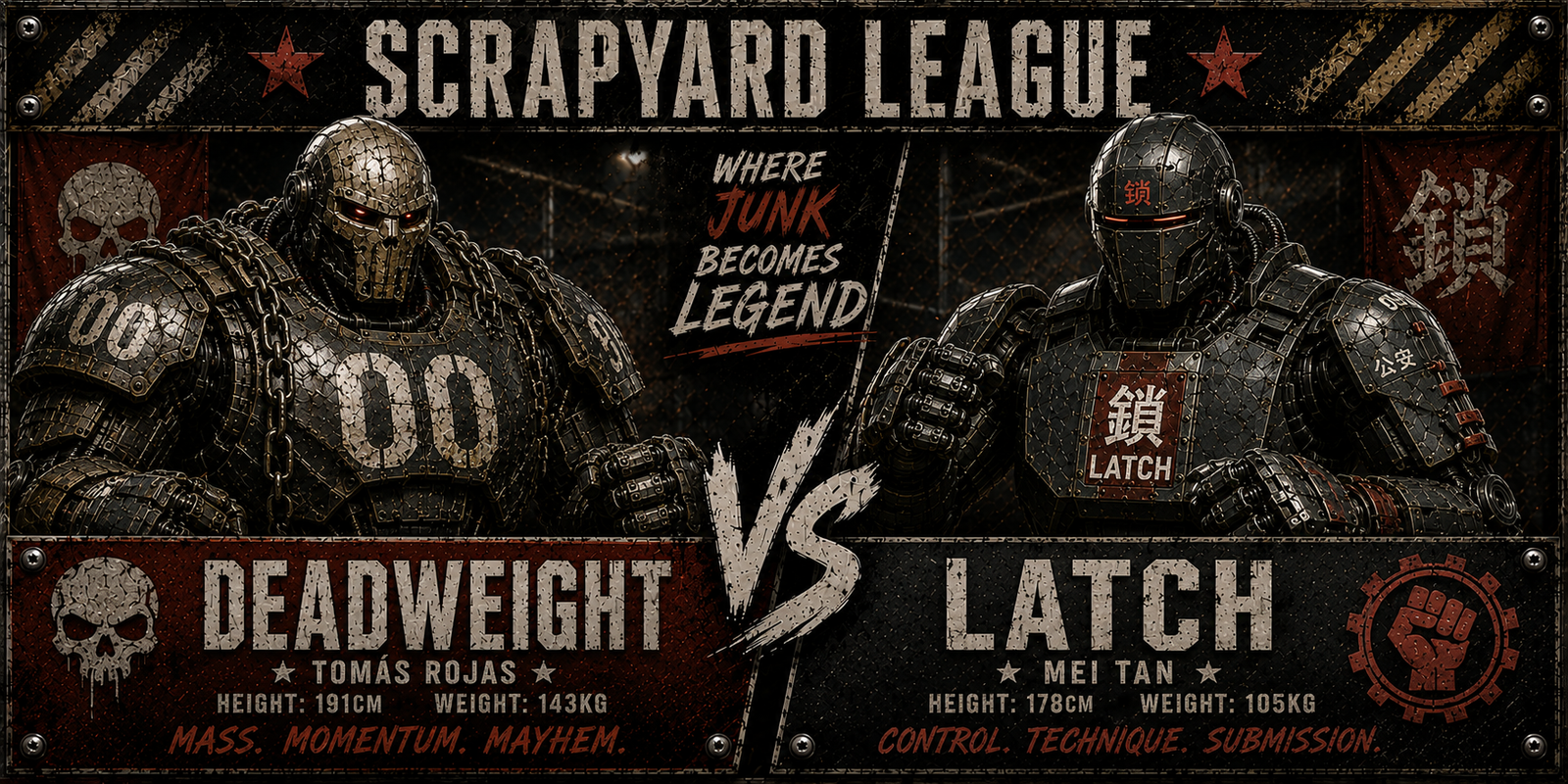
Deadweight entered his fight against Latch still searching for his first official victory.
Latch was faster, more technical and capable of exploiting the same weaknesses Tin Saint had exposed.
The opening Turn appeared to confirm those fears.
Latch attacked Deadweight’s damaged left leg, escaped his pressure and forced him to operate at an uncomfortable pace.
But the redesigned cooling system changed the fight.
Deadweight remained patient.
He stopped wasting movement, protected his damaged leg and waited for Latch to enter his reach.
When contact came, Deadweight established the clinch.
He used Dead Load to resist a takedown, trapped Latch against the barrier and applied Compression Clinch repeatedly.
Latch escaped once, but every escape required energy.
Deadweight continued forcing the faster machine to work.
By the third Turn, Latch’s Heat systems began to fail.
Deadweight secured another clinch and maintained pressure until Latch suffered a Heat-induced processor interruption.
The referee stopped the fight.
Deadweight released the hold immediately.
The victory was not spectacular.
There was no knockout, dramatic throw or final destructive strike.
Deadweight won by making a technically superior opponent spend more energy than its systems could survive.
It was his first official victory.
More importantly, it proved the qualification performance against Tin Saint had not been an accident.
Deadweight was no longer an exhibition relic trying to show that he belonged.
He was a legitimate competitor capable of defeating skilled opponents.
Tomás used part of the prize money to fully restore Deadweight’s damaged left leg.
The right leg still carries damage, and Deadweight’s Slow Recovery remains a serious threat.
One bad fall could still decide a fight.
One expensive defeat could still place the team under severe financial pressure.
But the old wall has now won for real.
The question is no longer whether Deadweight can compete.
It is how far an obsolete giant can go before the cost of keeping him standing becomes too great.
SUPPORT DEADWEIGHT
Support Deadweight and Tomás as they continue their Scrap Yard League campaign.
Paid supporters can help influence future story developments, team decisions and the direction of Deadweight’s season.
Can Tomás keep the giant operational against faster and more advanced machines?
Can Deadweight overcome the Slow Recovery weakness that has followed him throughout his career?
Or will the cost of preserving an irreplaceable obsolete fighter eventually become more than one working mechanic can afford?